Healthcare from the perspective of a clinician encompassing both the capture of the clinical viewpoint as well as the technology to help clinicians capture knowledge at the point of care
The thoughts expressed are my own and do not necessarily represent those of Nuance
A survey conducted at HIMSS15 found that patient satisfaction
and patient engagement rank among the top priorities for CIOs. In fact, they rank above improving care coordination, streamlining operational efficiencies, and achieving Meaningful Use.
The tides are clearly changing. We’ve all been talking about what the shift to a value-based care model means for healthcare organizations. What we haven’t been talking about is how this shift is transforming our patients into “prosumers.”
There’s a saying, “To a worm in horseradish, the world is horseradish,”
meaning we are predominantly aware of that which we are surrounded by on a daily basis. Health IT, in all its intricacies and expansiveness, has become hyper focused on making sense of its nebulous infrastructures, working hard to prepare healthcare organizations for next new wave of regulations. Our world, while not horseradish, is composed of goals and milestones that are 100 percent contingent upon these systems.
But, as yet one more unintended consequence of this pursuit, we have become myopic. The business of healthcare is no longer simply confined to a hospital or an IDN site map.
Patients are reaching for their phones, not to call their doctors, but to research their symptoms. They’re educated buyers, looking up reviews before seeing a new specialist, just as they would before buying the latest gadget on Amazon. And, as we enter the era of the Internet of Everything (IoE), they want their wearable devices to meaningfully connect as simply as when they use their phones to play songs from the playlist on their laptop.
It becomes a challenge of sustaining the momentum of the moment. As the wearable trend continues to grow, it is not merely enough to count steps or measure the amount of UV rays absorbed. That won’t keep patients engaged. We need statistics and personal health trends that can be used to foster a richer, ongoing dialogue between patients and their physicians.
Consider the positive health implications for patient who receives a treatment plan from her doctor, which is entered into the EMR during the visit and connected to a three-question daily check-in for three months via a mobile device. The patient could provide a thumbs-up, thumbs-down, or neutral rating (think Pandora playlist) on how the treatment is working, with perhaps an option to enter free text should she choose to expound upon her responses. These daily reports could be aggregated into trends and reviewed by a clinician to make adjustments to the treatment plan as needed, extending patient care beyond confines of the four walls and the 12 minutes of an office visit.
Connectivity and personalization is the zeitgeist. CIOs know this. We are all unique snowflakes, and as more and more people submit their genes for analysis and mapping, we’re proving the increased drive for individuality. While the industry is pushing for population health (a laudable vision indeed), patients are looking not to be considered in aggregate, but to be treated with the same personalized attention they experience when they go to a favorite restaurant where the wait staff recalls their usual order or when they go to a website that remembers all their previous preferences. It’s about not starting from square one every time. Patients aren’t going to tolerate the disconnect in healthcare forever. And as digital natives,some generations won’t tolerate it at all. The day is coming where a patient will ask her doctor, “Did you notice that that my headaches seemed to lessen on those days I go to the gym? I’m wondering if there’s a connection?” If her physician isn’t paying attention to her, she will find a physician, or perhaps even an intelligent medical assistant, who will.
We will be discussing the opportunities and challenges associated with the current digital healthcare revolution and of course how speech plays an essential role in integrating this technology while maintaining the human component of medicine that we all want. Rather than Neglecting the patient in the era of health IT and EMR
We have progressed from the world of Sir Lancelot Spratt
And the Doctor need to look at the patient not the technology perhaps in a cooperative Digital Health world like this
Is this future of Virtual Assistant Interaction good, desirable
I have the privilege of spending a lot of time on the road interacting with clinicians around the country (and world). I hear with too much frequency many doctors complaining about the Electronic Medical Record and how it fails to help them and in many cases makes their work harder. Some of this is a hangover from the past and the inadequate technology and in some cases hardware at the time
In fact I’ve told this story a number of times that I can date to around 1995/6 and in this piece: Clinical documentation in the EHR
Many years ago, an excited friend who worked for one of the electronic health record (EHR) vendors at that time — it was really more of a billing and patient tracking and management system than an EHR — was desperate to show me some of their latest applications. In particular, a new module they had developed to capture clinical data.
My friend pulled out his laptop, fired up the application, selected a patient and proceeded to enter blood pressure (BP). Some 20-plus clicks later, he had entered a BP of 120/80. While he was excited, I was dumbfounded. When it comes to patient care, doctors didn’t have time for 20 clicks to record BP years ago and they definitely don’t have that luxury in today’s demanding medical environment.
There is still some of that going on and not enough focus on the User Interface design and turning the technology into a barrier - this is the focus of the Art of Medicine campaign we launched some weeks ago
This article on Government HealthIT Are electronic health records already too cluttered? highlights a rising problem and one I hear about frequently. This is not just a healthcare problem and it is the focus of the work by Edward Tufte an American statistician and professor emeritus of political science, statistics, and computer science at Yale University who is well known for his books on information design which are bets acquired by attending one of his frequent courses on data visualization
Here is a recent overview of visualization on the iPhone
He has a section on healthcare but many of his principles apply
For Brian Jacobs the problem was even more acute working in a Pediatric ICU:
The ICU is a very toxic and tech-laden environment….because of that, it offers the opportunity to make a lot of mistakes
As he points out much of the cutter derives form the multiple notes entered into the EHR every day. "It’s not uncommon in teaching hospitals to have six to seven notes per day on one patient, by the time the attending physician, residents, consultants, other doctors and fellows check on the patient."
So they instituted a policy of One Note per day
Actually its
It’s actually one note per team per patient per day; one giant multi-contributor note. They still may be all writing their components, but it’s one note
With a template to hold the content generated each morning by the resident and then everyone contributing to that one note, adding and amending as necessary
So in addressing the issue clutter they also addressed usability and design turning the note into a living breathing document that is updated and maintained by the team that now takes care of patients
But he addressed some other important issues - especially when it comes to quality of care and the quality of the medical note
Copy Forward is subject to some warranted scrutiny from a billing and audit standpoint. Much of the repetitive and “clutter” in the note comes form the copying forward of past information. But:
These notes should never be the same
And as part of that message they moved to an "End-of-day note” that was a fresh summary of the patient.
Add to that an updated and well maintained Problem List and integration with the billing system to allow doctors to select their code for the work carried out that day and they moved to a valuable addition to the healthcare team in delivering quality healthcare with their EHR
EHRs are: more complete, legible, accessible and can be auto-populated and searched. They can provide diagnosis codes and they’re good for billing. On the other hand, they can sometimes lack quality information and are by far, too cluttered.
I said this back in 2003 (yikes!) - The Future of Technology is already here - Who’s on Board the train and who’s left at the station. I still believe it and understand that the technology does need to get better and be more integrated into the existing workflow
The next generation of health care technology is here, with visionaries and futurists pushing the envelope to enhance, create and generate the newest cutting edge in health care delivery. Advances in technology, like advances in medicine, are a shared entity that enhances life expectancy and the quality of life.
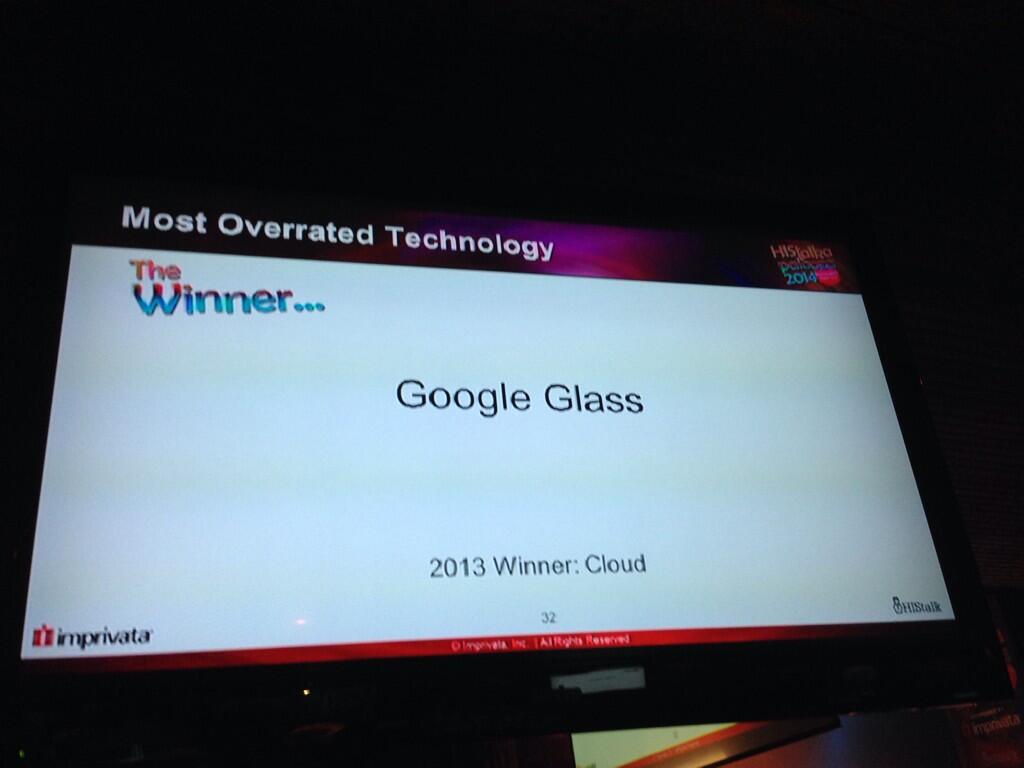
I know I am biased as one of the lucky Google Glass Explorer as can be seen in this post from MedCity Watching for Wearables at #HIMSS14:
I think they are wrong and its not just Glass that will provide better more ready access to essential clinical data.
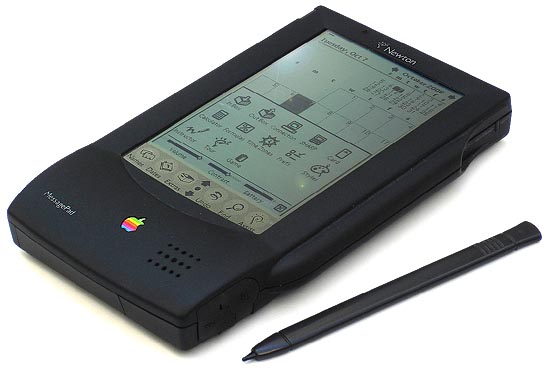
Not to say that the initial program like many launches have had their problems with early releases of technology not quite ready for prime time - remember the 1987 Apple Newton:
Mat Honan (one on the same “Epic Hack”) wrote a piece about his early experiences “My Year with Google Glass” that highlighted some early acceptance challenges
Glass is socially awkward
People get angry at Glass
Wearing Glass separates you
and I would add Glass interrupts normal conversations and social behavior - but that is all now and like the mobile phone I believe it will be come a natural part of our technical fabric. Think back to 2007 and how pulling out a phone in a meeting was frowned upon - now it seems part of the fabric of many of the meetings I attend.
But it was Mat’s commentary on the impact it had on his perception fo phones that really stuck out for me
Glass kind of made me hate my phone — or any phone. It made me realize how much they have captured our attention. Phones separate us from our lives in all sorts of ways. Here we are together, looking at little screens, interacting (at best) with people who aren’t here. Looking at our hands instead of each other. Documenting instead of experiencing.
From initial diagnosis through to surgical therapies, chemotherapy treatments and even end-of-life care, my job is to listen, assess and provide educated decisions that ultimately impact the health and wellness of another human being…. it’s my belief that when talking face-to-face with a patient about a care plan aimed at eradicating their body of a disease that threatens to take them away from their family, there’s no room for paper, computers and/or mobile devices. In these most intimate of conversations, the focus has always and must remain on the communication between the caregiver and the patient on the receiving end. That, in its purest essence, is what practicing the art of medicine is truly all about.
That’s not to say that Google Glass can solve this problem and in its current state and acceptance it might cause more challenges - but the potential is there to blend information access and capture into a physician patient interaction that remains all about the patient
Glass will provide improved access to essential clinical data to clinicians but as my friend Chuck Webster has pointed out on several occasions this is not just for clinicians. Patients are already accessing the internet in droves for clinical information, researching their conditions and that of their relatives and communities abound with resources and support for conditions from common to rare.
Before talking about some of the potential medical applications it is worth detailing the technology. Google Glass is basically a computer with 12Gb of memory attached to your head in the form of glasses. It has a heads up display with voice activation and has some apps that can be installed:
Facts
Google Glass is basically a computer attached to a pair of glasses
Google Glass has a display that is projected in front of the Right Eye that is a high resolution display equivalent of a 25 inch high definition screen from eight feet away
Google Glass has a camera that points forward and can take pictures (5MP) or video (720p) that is closely aligned with the view you see from your own eyes
Google Glass is voice activated using speech recognition to interact with the glass computer
Google Glass works best when connected to the internet
Google Glass Integrates with an Andorid Phone with a limited set of functions available for the iPhone
Google Glass has no built in illumination so pictures or video taken in dark conditions do not work well
The screen can be hard to see in bright light
There are many myths circulating:
Myths
If someone is wearing Google Glass they are recording me
False - The device is not set up to record continuously and will only record a video or photo based on an action by the wearer (either a spoken request
OK Glass, take a picture
or by pressing a button on the google glass device
Once Someone Has recorded something on Google Glass it is Publicly Posted
False - it requires an action on the part of the Glass owner to post the material to the internet otherwise it resides on the Google Glass device. It will be synchronized with the users Google+ account for automatic backup (much like photos are backed up from the iPhone to iCloud but like iCloud remain private to the user unless they elect to share them)
Google Glass is constantly capturing data and transmitting it to the Internet
False. Without an internet connection Google Glass simply stores any recorded information in the glass memory. And unless you have set it to record there is no data being captured
Google Glass tracks users and unsuspecting bystanders
False - Google Glass is not tracking or recording anything unless instructed to do so by the user
So who is using this technology, where are they using it and how are they using it in Healthcare. This article covered some of the early concepts and featured a short list of potential applications
Video sharing and storage: Physicians could record medical visits and store them for future reference or share the footage with other doctors.
A diagnostic reference: If Glass is integrated with an electronic medical record (EMR), it could provide a real-time feed of the patient’s vital signs.
A textbook alternative: Rather than referring to a medical textbook, physicians can perform a search on the fly with their Google Glass.
Emergency room/war zone care: As storied venture capitalist Marc Andreessen proposed in a recent interview, consider ”dealing with wounded patients and right there in their field of vision, if they’re trying to do any kind of procedure, they’ll have step-by-step instructions walking them through it.” In a trauma situation, doctors need to keep their hands free.
Helping medical students learn: As suggested by one blogger, a surgeon might live stream a live — and potentially rare — surgery to residents and students.
Preventing medical errors: With an electronic medical record integration, a nurse can scan the medication to confirm whether it’s the correct drug dose and right patient
In its simplest form just transmitting images in real time can offer some advantages for diagnosis - in Rhode Island they are planning on implementing Google Glass for the ED doctors to obtain real time consults with dermatologists.
And this from Kareo showing a patient education application that records the physician patient interaction and then makes it available afterwards for additional review:
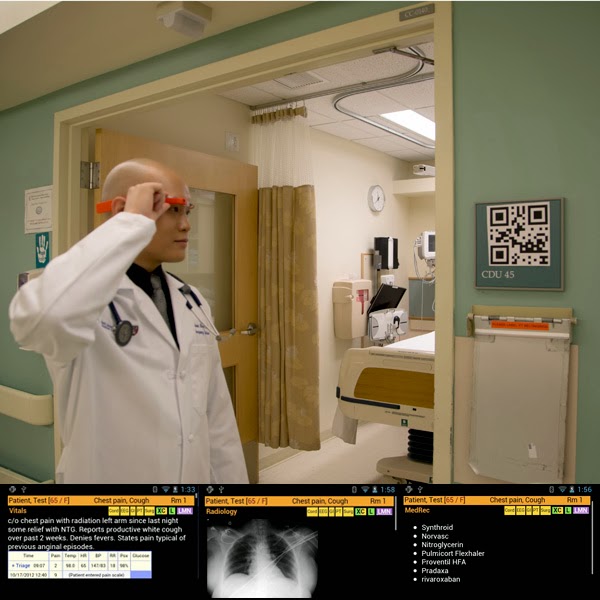
When a clinician walks into an emergency department room, he or she looks at [a] bar code (a QR or Quick Response code) placed on the wall. Google Glass immediately recognizes the room and then the ED Dashboard sends information about the patient in that room to the glasses, appearing in the clinician’s field of vision. The clinician can speak with the patient, examine the patient, and perform procedures while seeing problems, vital signs, lab results and other data.
And this concept by the way was top of everyone's wish list that I talked to in my unofficial survey of engaged and interested observers of my own pair. I'll paraphrase
If I could get it to recognize someone and provide me with their name when I meet them that would be fantastic!
But it is in urgent care where there is so much potential:
"If I want to look at for example radiology I can double tap ‘radiology...There's his chest x-ray, it just popped up, oh he's got a middle lobe pneumonia"
Part 2 will cover medical applications and how Google Glass technology can be applied in a busy clinical setting
During a recent and troubling discussion with a physician friend, he described to me a new ailment he’s been experiencing: waking up in the morning, and not looking forward to going to work. The reality is that he is not alone. It’s no secret that physicians across the country, regardless of their specialty or location, are reaching their limit for juggling new requirements, technology upgrades, and policy changes, all while trying to deliver personalized, quality care to their patients. As a result, busy physicians are, quite understandably feeling pressured and pulled away from direct patient care and critical clinical-decision making, and, at the end of the day, that is what matters most to patients and physicians alike.
It is easy to imagine the impact overloaded and dissatisfied physicians could have on Hospital Consumer Assessment of Healthcare Providers and Systems (HCAHPS) scores, and how these regulatory pressures and so many new healthcare technologies could be linked to the decline of the “art of medicine.” But are we, in fact, misdiagnosing the problem?
A recent study from Johns Hopkins University found that internal medicine interns are lacking proper bedside etiquette, which is not only essential to providing quality care, it directly impacts medical outcomes and patient satisfaction scores. Focusing on five key elements of proper patient-physician decorum, researchers tracked whether or not hospital interns:
Introduced themselves,
Explained their role in the patient’s care,
Touched the patient,
Asked open-ended questions, or
Sat down with the patient during the visit.
Results revealed that interns touched their patients (either during a physical exam, handshake or gentle, supportive touch) 65 percent of the time and asked open-ended questions 75 percent of the time, but introduced themselves only 40 percent of the time, explained their role merely 37 percent of the time, and actually sat down during only nine percent of the visits. Such results are disconcerting, at best, and reveal a more pressing truth: These basic and critical communication deficiencies that are essential to providing holistic patient care are not being taught.
The study exposes the reality that the shift away from patient focus and the “art of medicine” isn’t just stemming from increased physician workloads caused by new policies and changing technologies. It is infiltrating our profession through a change in training, as well. While we have reduced junior doctors’ work hours for safety reasons, we have not adjusted the overall length of training they receive. Medical students, our future physicians, are not receiving the holistic education that helps them balance keen scientific skills with compassionate delivery.
But, as they say, “knowledge is power,” and now that we are starting to pinpoint conditions that are tearing at our profession, we can start to heal them. We can’t expect our medical interns to know how to handle difficult and emotional situations unless we show them. We need to teach them how to engage with patients, earn their trust, really listen and understand them. They need to be able to view what their patients say through both a lens of science and medicine, as well as a lens of compassion and caring, in order to help them get and stay well.
And what of the technology challenges that are driving wedges between patients and physicians? While there is no denying that much of health information technology is putting pressure on physicians and forcing them to adapt to new methodologies, these challenges are a necessary to revolutionizing patient care. They are, in essence, the basis of growth and the very nature of science. If it weren’t for boldly trying new approaches, we might still be relying on leeches and blood-letting to cure melancholia. Just as we can’t expect a patient with heart disease to know intrinsically to maintain a low-sodium diet, we can’t expect the healthcare industry to know how to fix everything unless we speak up and advocate for change (especially with the other loud voices of insurers and politicians speaking on “our behalf”).
We must be mindful that as physicians, it is our sworn duty to defend the practice of delivering the best care to our patients from anything that threatens to impinge on that quality. We need to stay engaged and be responsive; and that also means we need to assist with diagnosing major technology pain points and identify when something isn’t working. We have the rare opportunity to shape the future of healthcare infused with technology and I, for one, want to be part of developing a solution that helps the next generation of physicians offer that comforting touch as they deliver an even greater level of care to their patients.
Video of the presentation from the Health2.0 show in October 2013 of the Florence Demonstration
You can see Florence in action at the site
or in the video below
It's a long time ago but in many respects that first shift is still fresh in my memory and it all came flooding back when I read this great piece by Deepak Chopra: My First Job: My Dark Night As A Real Doctor
He recounts his first night on call having arrived in to work in a 400 bed community hospital in New Jersey in the 1970's and his first patient - "an expiration"
I cast my mind back to Friday 1st August 1986 and my first day - the Friday was significant as I discovered, marking the beginning of a weekend on call that commenced on Friday at 9am and finished at 5pm on Monday 4th August - yes that 80 hours! I don't think I quite understood what that meant but I sure did by the end.
I was partnered with my medical school friend and colleague Niamh Anson part of my graduating class from the Royal Free Hospital School of Medicine. We were set to spend the next 6 months joined at the hip spending more time with each other than some married couples spend together. We would be each others support, backup, confidant and friend. I was lucky - she was the perfect balance to my brash youth and over confidence. She was a steady hand guiding through what were some very rough seas and although I did not know it at the time I was really lucky to be her partner offering me the chance to get to know her.
We worked for two consultants - Dr Woodgate and Dr Willoughby a cardiologist and a gastroenterologist and were joined by a dynamic registrar John Lee. Between us we took care of the cardiology patients, coronary care ward, coronary care monitoring unit and the gastroenterology patients day to day. But come Friday afternoon took on medical responsibility for all medial patients, medical admissions through the Accident and Emergency Department (A&E aka as the ED) and the Intensive Care Unit. On top of that we (Niamh, John and I) were the code team - with the anesthetist (aka Gasman or Anesthesiologist) as the 4th member. I don't remember how many patients this covered but it was a lot.
Our first day was filled with taking on responsibility for the day to day activities finding out how to get things done, where things were kept and most importantly getting to know the nurses who were the key to surviving the ordeal since they knew everything, had worked there for far longer than you (and many others) and had more relevant experience that you needed to learn from. I was reminded of the "Doctor in the House" film with Sir Lancelot Spratt from years back:
To be a successful surgeon you need the eye of a hawk, heart of a lion and the hands of a lady
And while I don't remember all the nurses by name I remember all their kindness, support and actions that helped me survive the grueling assault course of medicine.
At 5pm we knew the patient load had changed as our "beepers" (aka pagers) started sounding like a cardiac monitor going off so frequently. There were missing orders for pain medication, tissued drips (a drip that was no longer working and needing to be re-done), admissions in the emergency department, patents with abnormal rhythms on the coronary care intensive unit, blood gases needing taken in ICU.....
Division of labor and unofficial coordination became the order of the day as Niamh and I split the work taking on admissions and ward coverage. I remember during that period working out my rate of pay based on the number of hours I did per week (typically 136 hours per week) and thinking that while I understood that I was inexperienced I felt worth a little more than the £1.36 per hour (roughly $2.20 per hour) given that I recall all the critical clinical decisions we made, the CPR we performed, the relatives we had to speak to give them the sad news that their spouse had died.
By Saturday afternoon we had been on call for 36 hours and there seemed no let up in activity. The nights were sometimes quieter but that was rarity. As a means of coping we split the night with either Niamh or I taking all the calls after midnight (except in the case of a code when it was all hands on deck necessary to cope with the high work load in these events). In one memorable night I remember 23 admissions coming through the emergency department - if I saw my bed it was never for more than a few minutes. The nurses were all familiar with the work load adn they knew when they paged us that even if we answered and said we were coming they would oftentimes have to page us a second and third time as we would answer but then fall immediately back to sleep. As for our performance and efficiency - I hesitate to imagine how poor we were at tasks and what our decision making would look like if it were assessed. The good news was that there were many experienced nurses involved who did not work the same hours so were not suffering the same chronic sleep deprivation and were checking up on our orders and activities, prompting and intervening as necessary to prevent errors
By Monday morning we were all frazzled - I'd lost count of the patients and problems we had dealt with, the patients who had died, the admissions and therapies started and the slew of clinical problems and disasters we had averted. We stopped taking call but our day did not finish then and for us Monday was a regular working day dealign with the normal work load of admissions, award rounds treatments and patient management. It was only at 5pm on Monday evening we finally stopped work and handed our patient cover over to the new on call team.
There was some solace in the genuine feeling that you were making the difference in people's lives but much like Deepak Choopra I struggled with what I was actually delivering - was this really healthcare
In the end, after six years of studying, medicine was turning out to have too little to do with healing and making people happy. It had to do instead with my work in the hospital, into their lives, pronouncing a few of them, the most unlucky ones, as expirations. I thought about myself a lot before I forced myself to sleep, but, on reflection, I didn't think about my patients much. We had all met and parted in a few moments. It would have been hard to look at them directly.
What of the interaction as defined by Hippocrates
Even though a patient may be aware that his condition is perilous, he may yet recover because he has faith in the goodness of his physician...I will keep pure and holy both my life and my art.
I did not have a good feeling about the interactions - the fleeting exchanges with these people who were trusting me with their lives and the lives of their family. And as technology and innovation continued its march the reality of the practice of medicine changed
Practicing medicine as we do now makes a doctor's life as nerve-racking as a soldier's. It consists of an endless struggle to conquer disease, and to keep at this, a doctor must deny to himself that disease, and to keep at this, a doctor must deny to himself that disease ultimately wins. If you feel called to practice medicine, these are not the kinds of thoughts you permit yourself. But doctors do face up to them from time to time and wonder what the work is for
I had some great experiences - I had some awful ones and I continue to be part of what I consider an honorable profession and one I am privileged to be a contributing member . In fact on a recent flight there was a request for a doctor - a lady suffering an attack of pancreatitis but fortunately we were not far from our destination and my contribution was small and mostly not medical in nature helping to control and comfort for the short period of time till we arrived and then hand the patient on to the ground emergency medical staff. That transition proved to be sub-optimal and it was well over an hour before she was taken care of - I stayed of course, wanting to be sure that her care was transferred to the healthcare team on the ground. The following day I received a note from one of the flight attendants that made my day. She had searched for my name and found me and sent a note to the Nuance Web site thanking me for my assistance and complimenting me for my "display of genuine heart". My contribution was not so much medical although that had played a part in the diagnosis, assessment and review of treatment options and the course of action. But what had made the difference was compassion - the focus on the person (and in this case there were two people and I ended up helping her companion navigate London Heathrow airport late at night to get her out to the accommodation they had booked). I had never doubted what I would do and was upset for this lady and her companion who's holiday was not starting off well. This is why I did medicine - I wanted to be the contributor, the person caring for the patient. It is this fundamental aspect of medicine we seem to be loosing site of - I can certainly accept some blame - I have a keen eye towards technology and possibilities it offers - but at its hearts medicine is about people caring for people and providing the support that in many cases is the difference between a good or bad outcome (at least perceived by the patient anyway). In fact I tweeted something along these lines earlier this week:
People forget what you said and what you did but they remember how you made them feel
— Nick van Terheyden (@drnic1) November 4, 2013
People forget what you said and what you did but they remember how you made them feel
As Deepak Choopra quotes:
Rejoice at your inner powers, for they are the makers of wholeness and holiness in you,
Rejoice at seeing the light of day, for seeing makes truth and beauty possible.
and he ends with
a physician must trust in Nature and be happy in himself
As a guding light that works for me - hope it works for you too
I ran across this posting on Mark Hindle's Twitter account:
My Nan is in well publicised poorly performing hospital, this was in her notes last night - paper towel prescribing! pic.twitter.com/BdlLYy1gxD
— Mark Hindle (@mhindle2) August 15, 2013
The picture is shocking:
This is not just a hand written note as a simple reminder...this paper towel addresses the Pharmacy and says
Like many in the healthcare IT industry, I was saddened by the announcement that Dr Farzad Mostashari (@Farzad_ONC) would be retiring. I would suggest as famed football legend Vince Lombardi said
"The strength of the group is the strength of the leaders"
And, for healthcare technology, Dr. Mostashari has been a great leader. I’ve outlined below some of the many contributions he has made to healthcare.
Dr. Mostashari joined the Office of the National Coordinator (ONC) in 2009, and has had a huge and positive impact on the implementation, development and overall perception of healthcare IT. Personally impacted by the state of healthcare when his mother was admitted for arrhythmias, after having asked for the paper chart, he admitted;
I couldn’t even read the cardiology consult’s name
Perhaps this is one of the reasons he like me is a proud member of Regina Holliday (@ReginaHolliday) "Walking Gallery". This difficult, and highly personal, situation likely galvanized his vision as he took on the daunting tasks demanded by the role of the ONC. He inherited a department that had, in effect, been pushed over the edge of the luge and, whilst speeding wildly along this track, was expected steer a course that would deliver on a range of programs in record time:
Meaningful Use of Electronic Health Records (EHR)
Certification program for EHRs
National Standards
Grant programs
Regional Extension Centers
And that was just what he knew about coming in. The team endured the challenges, weathered the storm in the "Office of No Christmas"
He rapidly earned a reputation as a leader who listened and was engaged. He made many appearances and, although he may not have been the first, he was certainly an early adopter of social media and online engagement – clear indicators of his heartfelt passion to be part of the solution. As a customer service representative I recently encountered very astutely pointed out:
I can't do anything about the past, but I can help improve the future
Successes
It is hard to pick individual highlights from such an impressive record, but here's my list of Dr. Mostashari’s top 13 achievements and quotable/notable moments from his time in office:
Successfully delivering on the Stage 1 Meaningful Use, despite frustrations and the challenges of a fickle and change-resistant healthcare profession. He gracefully offered a personal hand to help steer his colleagues: "Meaningful use is the best-we-could-make-it roadmap to prepare for delivery of higher quality care and mitigating some of the costs toward getting there, if it's a distraction we need to change it, and I want to hear from you personally."
Creating a viable technical assistance program that has touched many providers and hospitals through regional extension centers (REC).
Driving the successful adoption of electronic health records (EHRs) and electronic medical records (EMRs).
Interoperability (see note below on focus for the future)
Pushing for patient empowerment (He, like me, is a proud owner and runway model for the Regina Holliday Healthcare Collection).
As he said: "We’re on the right track to make meaningful use of meaningful use"
ePrescribing
And as if to prove the point about his use of social media, this from his twitter feed: “We've made more progress with EHRs in the past 2 years then we have in 20"
Championing the patient engagement he stated: "We cannot have it be profitable to hoard patient information"
Nailing the coffin shut on paper he said: "Once you close a paper file it's dead. You’re not able to move it or learn from it"
While this may not be his own personal quote but he applied cyberpunk science fiction, William F. Gibson famous quote to healthcare: “The future is already here – it’s just not evenly distributed.” by pointing out that we do have the technology - its just not being applied
Piloting Meaningful Use stage 2 criteria, which built on the success of stage 1, and pushed towards interoperability including standards for data sharing data, quality improvement, and quality measures that foster patent engagement. As he put it: "We are using every lever at our disposal to increase the sharing of information" and "Patients need to care for themselves and become partners in their care"
Successfully weathering the storm of the controversial (or as he put it "headline grabbing") Health Affairs article based on data from 2008 that suggested that EHR technology was increasing the costs of healthcare.
The Future:
To the lucky individual taking the reins, I offer five suggested areas of focus:
2.A friend once said to me: "You've put us on the horse, you might as well give us the ride." The same can be said of payment reform, which must shift from quantity-based to quality-based payment. And taking a sheet from Dr Mostashari's play book, every journey starts with a single, small action, so even a small dent would be a welcome shift.
Continue the engaged and inclusive discussion with all the constituents and make social media a central part of that strategy both for ONC but also for the healthcare industry.
A friend once said to me: "You've put us on the horse, you might as well give us the ride" The same can be said of payment reform, which must shift from quantity-based to quality-based payment. And taking a sheet from Dr Mostashari's play book, every journey starts with a single, small action, so even a small dent would be a welcome shift.
I must include a shout out for patient engagement. Nowhere else in the industry will you find such a large and untapped resource that is ready, willing – but perhaps not yet able to participate in the change. As I have stated many times: when a doctor and patient are in a room, there is nobody, I repeat nobody, more interested in successful outcomes than the patient. Give them the tools and make them part of the solution.
Occasionally, the issue of Tort and Medical Negligence is raised, but it appears to have the "third rail" syndrome. Unless this is addressed, we will continue to see "defensive medicine" practiced. As I recently blogged in Science, Evidence and Clinical Practice, despite clear data that shows intensive monitoring causes more harm in normal care deliveries, we continue to see almost universal rates of this high-level monitoring. While some may be attributable to the payment system, I believe a large part of this volume stems from the general inertia of and fear of litigation.
Above all - have fun. I made this point at every soccer practice when I was a coach. If you aren't having fun, there is little incentive to do well or, for that matter, to do at all. I know I am constantly amazed at the great fortune that finds me at this intersection of medicine and technology. I constantly have that feeling as if I paddled for the wave just at the right time:
"Surf's Up dude - ten foot waves of the Pier"
The Making of the 21 Bow Tie Salute
Dr Farzad Mostashari has been an incredible role model, a source of inspiration and a true visionary who has helped others see what the future of healthcare can look like. And so, in extreme appreciation of all that he has accomplished, I offer this 21 Bow Tie Salute.
I was fortunate enough to have another wonderful role model, my father, take the time to teach me how to tie a bow tie, but for those of you wanting to learn the fine craft of tying a bow tie, instructions are included below (The 21 Bow Tie Salute was made with Real Bow Ties).
I had the pleasure of speaking with Alex Welz of Health Tech Vision last week and he posted the interview here - or you can listen to it below
The importance of bringing intelligent voice interactions to Health IT especially as medical technology moves to into the Mobile world. It is an exciting time with technology offering real hope
All truly great thoughts are conceived by walking Friedrich Nietzsche
Don't walk behind me; I may not lead. Don't walk in front of me; I may not follow. Just walk beside me and be my friend Albert Camus
I met Regina Holliday a while back at one of the many conferences that she attends:
At this conference she was there to present and was also creating a painting. Her reputation had preceded her and I was excited to meet her in person and hear her story first hand. I had seen some jackets at conferences and had discovered the story behind the Walking Gallery. An idea that came from a tragic story in a healthcare system that is broken
Back in 2011 a video was made featuring many from the gallery filmed at the Kaiser Permanente Total Health Center:
But there is nothing that could match the power of hearing this in person.
Regina offered to paint my story and it was months before I could pull together some photographs and sit down to articulate my personal journey in healthcare but that all came together a few weeks ago, almost in time for another walking gallery gathering. With so much going on Regina knew what she was going to paint but had not (as the picture shows)
managed to download it quite yet
My journey to medical school and joining an honorable and privileged profession started when I was still at school and I remember the seminal moment that made me realize this was the pathway I wanted to take:
I was visiting my older brother in London we exited from Victoria rail station just as somebody had been run over by a bus. I watched as my brother pushed his way to the front of the crowd and he stooped own while very one watched - he was a doctor and knew what to do. As I stood on the sidelines watching I realized that I want to be doing rather than watching
I was a very young medical student and while I enjoyed medical school there was no doubting the fact that I was dealing with something that was really quite unique and challenging emotionally. Life and death was part of normal clinical activities and shortly after my 22 birthday I graduated
I have been heard to joke that the TV Series Doogie Howser was modeled on me as that was some years later - he was also the original blogger.
My Story
Running Out of Time
Practicing medicine in the United Kingdom in the national health service which while delivering great care placed an enormous burden on the people delivering that care. The environment was challenging, especially for a young junior doctor and I found myself questioning what I'd let myself in for. My first clinical job I worked 132 hours per week, I had Tuesday and Thursday evening off. At the time, that was the norm and all of my colleagues had the same work schedule as I did and I noticed that my senior colleagues not only had that working schedule but also took on more clinical responsibility. My weekends were hellacious, waking up on Friday morning and not finishing until Monday evening. I shared the work with a colleague and friend by the name of Niamh Anson. We would share the on-call work and split the activities, with one of us covering wards and the other covering the emergency department admissions.
The constant and chronic sleep deprivation took its toll and I repeatedly questioned the job I was doing and indeed whether I was even safe. The nurses proved to be our saving grace and several occasions when we made mistakes through simple tiredness they caught these mistakes and quietly corrected or prevented our errors. I don't remember a single time of being on call when I wasn't up most of the night and typically at leas every hour. Rarely did this not require a visit to either the ward or the emergency department. Many the time, I would walk from my living quarters to the emergency department angry at the system that would place such a burden on anyone and wondering if there was something wrong with me.
On one particular day my two team members were not at the hospital. Niamh was on holiday, one which had been booked many weeks ago but as is normally the case medical staffing had failed as usual to find replacement. By two in the afternoon, the emergency department had 17 patients waiting to be seen by me, there was a patient in intensive care on a ventilator that was having problems, and the cardiac care unit had a patient that was having a lignocaine reaction. I reached breaking point and called medical staffing, and told them I was quitting. Their reaction, humorous in hindsight but at the time not, was to tell me that my contract did not allow for me to quit. Fortunately the ward sister from the cardiac care unit intervened and quietly called my two attending's. The next thing I knew I received a call from one of them asking me to meet him in the emergency department. I thought my career was over and proceeded down to meet him expecting to be blasted and read the riot act. I was pleasantly surprised to find my two consultants there stuck into seeing patients and helping me out. One of them admitted all of the patients in the ED department while the other dealt with the patient on the intensive care unit in the coronary care unit.
Between us we were able to triage and treat all the patients by the end of the afternoon. Even now as I think back to that story I still find myself quite emotional about the experience and support from two outstanding individuals. They rounded it out by insisting that we went to the local pub for a drink (non-alcholic of course) and listened to me and provided counsel and support.
Sadly they were not typical of the senior staff in the health system and most took the view that they had suffered this level of overwork and therefore everybody else should experience the same. This was a recurring theme throughout my time as a clinician and I found most disturbing and many times very depressing.
If I am walking with two other men, each of them will serve as my teacher. I will pick out the good points of the one and imitate them, and the bad points of the other and correct them in myself. Confucius
I remember vividly one instance where the attending surgeon I was working for heard that I was taking a sabbatical and thinking about leaving medicine. He started by saying that I was terrible shame, and I thought he was about to offer some guidance/support and thoughts about where the system is wrong and how I might cope with it. Sadly he proved to be similar to many of his colleagues and peers and felt that the system was wrong in allowing me into medical school. The system should of been better at weeding me out since there was clearly something wrong with me not with the system. He like many of his peers believed the baptism by fire, sleep deprivation and the general demeaning of junior doctors was an essential part of training and character building. As he put it, he had experienced this in his junior doctor days and he'd survived and done fine. What he failed to appreciate was that at the time he was practicing as a junior doctor, emergency call was typically a Porter coming to his door knocking on his door to tell him that somebody was "going off" and leaving a cup of tea for him. He would dress himself, drink his tea and proceed to the ward, where the patient had either died or survived, but there was very little that he could do to influence the outcome. My experience consisted of being surgically attached to an emergency page that would bark out at me at all hours, telling me to go to a ward or location in the hospital for an emergency resuscitation the could take anywhere from five – 60 minutes.
There is no easy walk to freedom anywhere, and many of us will have to pass through the valley of the shadow of death again and again before we reach the mountaintop of our desires Nelson Mandela
My friend and colleague Niamh Anson
had many of the same experiences and like several of my colleagues elected to move away from the system leaving the NHS for Australia, perhaps hoping that this system would be more bearable. Sadly some years later she committed suicide as too many of my colleagues and friends do.
So my Walking Gallery Jacket:
As Regina described the picture:
The sky represents the never ending shifts as does the hour glass. The medical students and doctors are all standing beside me, also exhausted. My friend and colleague Niamh Anson jumping off the hour glass due to stress....
The New Yorker author, surgeon, Harvard University faculty member, and health policy adviser Atul Gawande told the President's Council of Advisors on Science and Technology (PCAST) today that checklists could help improve the quality of health care and lower costs. PCAST members seemed enamored with the idea of standardizing treatment and procedures, and also discussed how to raise the academic status of those working in the field. But another PCAST member—Google CEO Eric Schmidt—saw what Gawande was peddling as a potentially lucrative new market for the search engine giant.
Here's Schmidt's dream of what a visit to the doctor will look like in 2015. It came during a question-and-answer session following Gawande's 15-minute presentation, drawn from his new book, The Checklist Manifesto: How to Get Things Right. You can judge for yourself whether it's sensible or scary.
"My question has to do with the model of health care that we'll be facing in 5 or 10 years," Schmidt began. "It's pretty clear that we'll have personalized health records, and we'll have the equivalent of a UPC sticker with your medical history. So when you show up at the doctor with some set of symptoms, in my ideal world what would happen is that the doctor would type in the symptoms he or she also observes, and it would be matched against the data in this repository. Then this knowledge engine would use best practices, and all the knowledge in the world to give physicians some sort of standardized guidance. This is a generalized form of the checklists that you're talking about."
Then Schmidt made clear what was troubling him. "As computer scientists, this is a platform database problem, and we do these very, very well, as a general rule. And it befuddles me why medicine hasn't organized itself around these platform opportunities."
Gawande took a shot at responding to the billionaire's bewilderment. "I think part of the bafflement occurs because the folks who know how to make such systems don't understand how the clinical encounter actually operates." But the bigger problem, he said, is that such a search would in all likelihood generate more heat than light for the harried physician, who typically has "15 minutes to manage six problems." According to Gawande, "the three inches of guidance, explaining what the evidence suggests and so on, needs to be turned into a useful form that tells you what you can do."
But Gawande is no Luddite. He told Schmidt that he'd welcome an app—"for your iPhone or whatever the new Google one is"—that could help him the next time he sees a patient diagnosed with a rare renal tumor.
Gawande found a receptive audience for his idea that the federal government create a National Institute of Health Systems Innovation to complement the work of the National Institutes of Health, although PCAST members suggested that he consider other administrative solutions. And they also shared his unhappiness with the relatively low status of health systems analysis. "My sense is that we don't respect this stuff," said PCAST co-chair Eric Lander. "We respect the cancer genome, but not checklists. What do we need to do to send a signal to the next generation of researchers that this is a high-class, worthy thing to do? What would it take to move the needle?"
"You're absolutely right," Gawande replied. "It's not well respected. There's a reason, after all, that I'm still an associate professor."
Older piece from 2012 but an interesting point made by the ever insightful and eloquent @Atul_Gawande when challenged by a non-clincinas who was "Troubled" by the state of #HealthIT. As Dr Gawande said
I think part of the bafflement occurs because the folks who know how to make such systems don't understand how the clinical encounter actually operates
There you have it - it is easy to look in to healthcare technology and prescribe solutions based on your experience of finance, computers, C++ coding and any other discipline. But if you don't understand the fundamentals of clinical care, the taking of a history and all the nuances involved in teasing out details from patients you can't prescribe a solution that will work effectively
And in a notable humbling point Dr Gawande points out that even within the fences there is resistance to much of the application fo this technology
You're absolutely right...It's not well respected. There's a reason, after all, that I'm still an associate professor


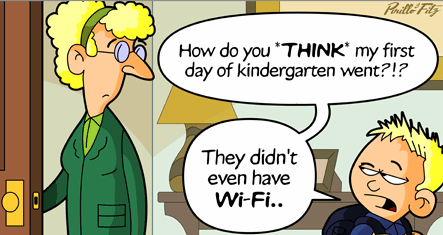 Patients aren’t going to tolerate the disconnect in healthcare forever. And as digital natives,some generations won’t tolerate it at all. The day is coming where a patient will ask her doctor, “Did you notice that that my headaches seemed to lessen on those days I go to the gym? I’m wondering if there’s a connection?” If her physician isn’t paying attention to her, she will find a physician, or perhaps even an intelligent medical assistant, who will.