Showing posts with label Clinical Informatics. Show all posts

Tuesday, June 17, 2014

We Must All be Engaged in the Design, Delivery, and Re-imagination of Healthcare

Previously posted on HITConsultant

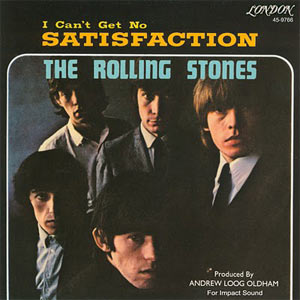
On a recent flight, I had my headphones on and the Rolling Stones’ “Satisfaction”

began to play.

It’s a song I have heard hundreds of times over the years, but I was struck by the difference listening to it with headphones made. With no distractions, I noticed the bass line, in time with the percussion, provides the perfect offset to Mick Jagger’s distinctively strained voice. It was a completely different experience than hearing the track play in the background of a movie or while at a restaurant. Being fully-immersed and listening only to that song allowed me to pick out and appreciate subtle details I had never noticed previously. It’s no surprise that things sound differently when you’re able to concentrate your full attention on what is being said, but as I was sitting there, I became acutely aware of the function headphones serve—they enable the wearer to listen, blocking out distractions.

That is exactly what we are seeking in healthcare and it has proven to be difficult to achieve – in part because of pace, complexity of care, and technology. For centuries, physicians have listened to their patients and relied on their senses— their powers of observation— and matched these insights with clinical experience to heal. Clinicians need to be able to listen and concentrate on what their patient is telling them and noticing those distinctive symptoms he or she may be exhibiting. As Sir William Osler


famously advised:

“Listen to your patient, he is telling you the diagnosis.”

Being able to dedicate your undivided attention to anything these days is a rarity, but in healthcare, it is a crucial but frequently missing element. The last thing you want to feel when you are at your most vulnerable is that your physician is multi-tasking. Patient satisfaction scores will suffer, but more concerning are the clinical risks and missed opportunities of distracted physicians.

Distracted clinicians are the result of what Dr. Steven Stack of the American Medical Association refers to as an “over-designed” health IT system.” In a recent discussion with industry leaders, he explained that we seem to have become victims of our own ambition. We have devised structures that don’t work for everyone and policies that create very real, very expensive consequences for those who don’t abide. And this has left physicians stretched too thin, trying to do more in less time without any direct impact on improving their ability to care for their patients.

So, maybe it’s time we scale back. Dr. John Halamka, CIO of Beth Israel Deaconess Medical Center and co-chair of the nation HIT Standards Committee, noted that while we are in this period of transition and growth, we need to focus on parsimony, or determining the smallest number of moving parts that need to be adjusted in order to create seamlessness in HIT. Quite simply put, while the cart has been upset, there is no reason to trample all over the apples.

The MIT Technology Review recently interviewed Sarah Lewis, a doctoral candidate at Yale, about her recent book that explores how different unlikely circumstances or paths, like failure, have often spurred innovation. Citing creative geniuses such as Cezanne and Beethoven to Nobel laureates, she defines failure as the gap between where one is and where one would like to be. Confronting this gap, she asserts, is important because it “lets people go deep with their failure while letting it be an entrepreneurial endeavor if they like, or an innovative discovery.” We, in health IT, are currently at that gap where there is a disparity between where we are and where we would like to be.

The recent ICD-10 delay has provided the perfect opportunity for us to find Halamka’s parsimony, leveraging solutions that work for physicians and creating consistency and impact wherever possible. Like medicine itself, there will be no one perfect solution for every physician or organization, but we need to begin finding things that work – from re-skinning EHRs with easy to use tools like single sign-on or mobility to systems that respond to voice, touch or swipe to improve the experience for clinicians and patients. We need to start thinking of health IT more like headphones, coming in different styles to suit preferences, but providing the same function of reducing distraction and enabling the clinician to focus on the inflections in their patients’ voices, and truly hearing what is being said.

As Mick Jagger poignantly remarked, “The past is a great place and I don’t want to erase it … but I don’t want to be its prisoner, either.” We have accomplished a lot, but it is time to learn from the past and break free from what isn’t working. I think we can get health IT satisfaction (despite what the song says), but to do so we must all be engaged in the design, delivery, and re-imagination of healthcare and its intersection with technology. This truly is the art of medicine and we are all virtuosos contributing to the next masterpiece of healthcare.
Tuesday, March 18, 2014

Google Glass in Healthcare - Part 1 the Basic Facts

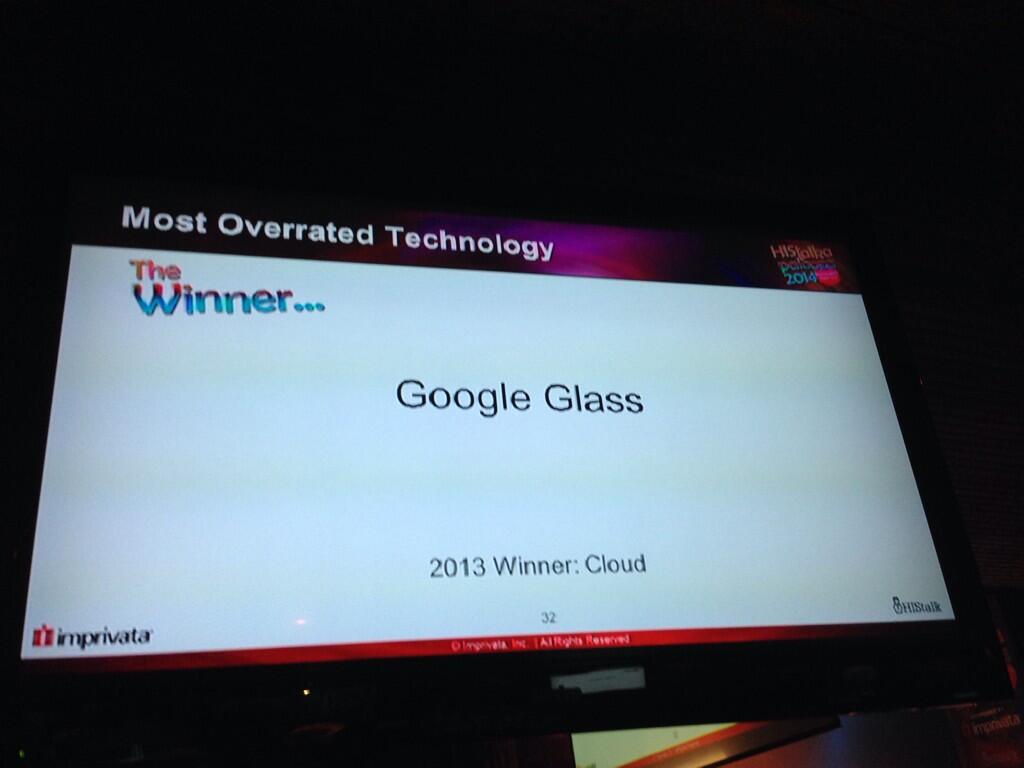
HIMSS was exciting and despite the HIS Talk HISies awarding Google Glass the most over rated technology:


I know I am biased as one of the lucky Google Glass Explorer as can be seen in this post from MedCity Watching for Wearables at #HIMSS14:


I think they are wrong and its not just Glass that will provide better more ready access to essential clinical data.

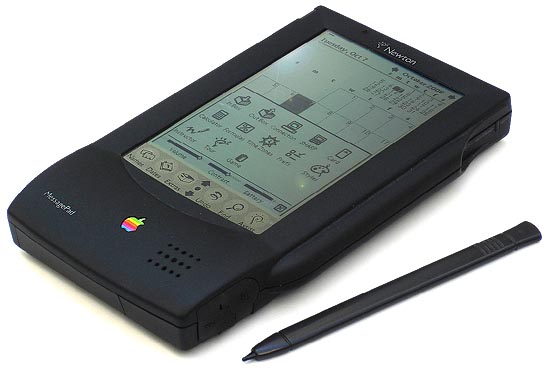
Not to say that the initial program like many launches have had their problems with early releases of technology not quite ready for prime time - remember the 1987 Apple Newton:

Even the omnipresent iPad struggled initially - most have probably forgotten the initial lukewarm reception of the iPad


had Apple talking about a price reduction.

Mat Honan (one on the same “Epic Hack”) wrote a piece about his early experiences “My Year with Google Glass” that highlighted some early acceptance challenges

  • Glass is socially awkward
  • People get angry at Glass
  • Wearing Glass separates you

and I would add Glass interrupts normal conversations and social behavior - but that is all now and like the mobile phone I believe it will be come a natural part of our technical fabric. Think back to 2007 and how pulling out a phone in a meeting was frowned upon - now it seems part of the fabric of many of the meetings I attend.
But it was Mat’s commentary on the impact it had on his perception fo phones that really stuck out for me
Glass kind of made me hate my phone — or any phone. It made me realize how much they have captured our attention. Phones separate us from our lives in all sorts of ways. Here we are together, looking at little screens, interacting (at best) with people who aren’t here. Looking at our hands instead of each other. Documenting instead of experiencing.
Which resonates with me an the Art of Medicine campaign and the struggle clinicians have with focusing on the patient (To learn more, download the eGuide Art of Medicine in a digital world). As Dr. Edward C. Grendys, Jr. said in his article: There’s no room for technology in end-of-life care decisions:
From initial diagnosis through to surgical therapies, chemotherapy treatments and even end-of-life care, my job is to listen, assess and provide educated decisions that ultimately impact the health and wellness of another human being…. it’s my belief that when talking face-to-face with a patient about a care plan aimed at eradicating their body of a disease that threatens to take them away from their family, there’s no room for paper, computers and/or mobile devices. In these most intimate of conversations, the focus has always and must remain on the communication between the caregiver and the patient on the receiving end. That, in its purest essence, is what practicing the art of medicine is truly all about.

That’s not to say that Google Glass can solve this problem and in its current state and acceptance it might cause more challenges - but the potential is there to blend information access and capture into a physician patient interaction that remains all about the patient

Glass will provide improved access to essential clinical data to clinicians but as my friend Chuck Webster has pointed out on several occasions this is not just for clinicians. Patients are already accessing the internet in droves for clinical information, researching their conditions and that of their relatives and communities abound with resources and support for conditions from common to rare.

Before talking about some of the potential medical applications it is worth detailing the technology. Google Glass is basically a computer with 12Gb of memory attached to your head in the form of glasses. It has a heads up display with voice activation and has some apps that can be installed:

Facts

  • Google Glass is basically a computer attached to a pair of glasses
  • Google Glass has a display that is projected in front of the Right Eye that is a high resolution display equivalent of a 25 inch high definition screen from eight feet away
  • Google Glass has a camera that points forward and can take pictures (5MP) or video (720p) that is closely aligned with the view you see from your own eyes
  • Google Glass is voice activated using speech recognition to interact with the glass computer
  • Google Glass works best when connected to the internet
  • Google Glass Integrates with an Andorid Phone with a limited set of functions available for the iPhone
  • Google Glass has no built in illumination so pictures or video taken in dark conditions do not work well
  • The screen can be hard to see in bright light
There are many myths circulating:

Myths

  • If someone is wearing Google Glass they are recording me
    • False - The device is not set up to record continuously and will only record a video or photo based on an action by the wearer (either a spoken request
      • OK Glass, take a picture
      • or by pressing a button on the google glass device
  • Once Someone Has recorded something on Google Glass it is Publicly Posted
    • False - it requires an action on the part of the Glass owner to post the material to the internet otherwise it resides on the Google Glass device. It will be synchronized with the users Google+ account for automatic backup (much like photos are backed up from the iPhone to iCloud but like iCloud remain private to the user unless they elect to share them)
  • Google Glass is constantly capturing data and transmitting it to the Internet
    • False. Without an internet connection Google Glass simply stores any recorded information in the glass memory. And unless you have set it to record there is no data being captured
  • Google Glass tracks users and unsuspecting bystanders
    • False - Google Glass is not tracking or recording anything unless instructed to do so by the user
So who is using this technology, where are they using it and how are they using it in Healthcare. This article covered some of the early concepts and featured a short list of potential applications
  • Video sharing and storage: Physicians could record medical visits and store them for future reference or share the footage with other doctors.
  • A diagnostic reference: If Glass is integrated with an electronic medical record (EMR), it could provide a real-time feed of the patient’s vital signs.
  • A textbook alternative: Rather than referring to a medical textbook, physicians can perform a search on the fly with their Google Glass.
  • Emergency room/war zone care: As storied venture capitalist Marc Andreessen proposed in a recent interview, consider ”dealing with wounded patients and right there in their field of vision, if they’re trying to do any kind of procedure, they’ll have step-by-step instructions walking them through it.” In a trauma situation, doctors need to keep their hands free.
  • Helping medical students learn: As suggested by one blogger, a surgeon might live stream a live — and potentially rare — surgery to residents and students.
  • Preventing medical errors: With an electronic medical record integration, a nurse can scan the medication to confirm whether it’s the correct drug dose and right patient

In its simplest form just transmitting images in real time can offer some advantages for diagnosis - in Rhode Island they are planning on implementing Google Glass for the ED doctors to obtain real time consults with dermatologists.

And this from Kareo showing a patient education application that records the physician patient interaction and then makes it available afterwards for additional review:


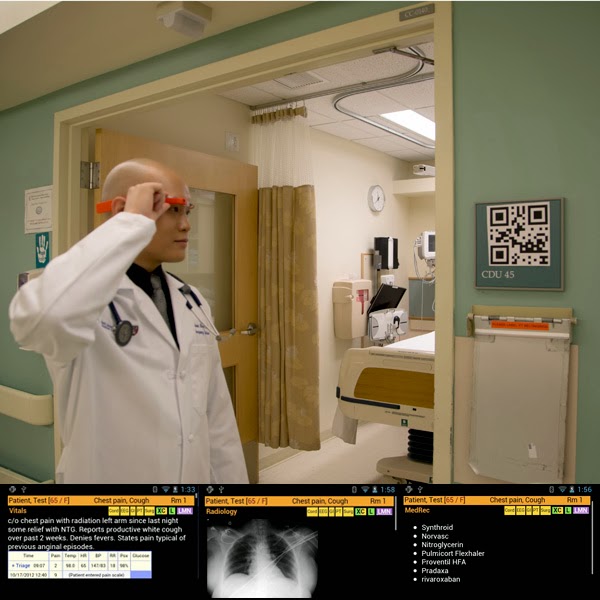
In this case featured in the ER doctors use Google Glass and QR codes to identify patients which featured Dr. John Halamka, CIO of Beth Israel Deaconess Medical Center which he talked about in his blog detailing their experience (oddly the article talking about this refers to text that appears to have been changed or taken down):
When a clinician walks into an emergency department room, he or she looks at [a] bar code (a QR or Quick Response code) placed on the wall. Google Glass immediately recognizes the room and then the ED Dashboard sends information about the patient in that room to the glasses, appearing in the clinician’s field of vision. The clinician can speak with the patient, examine the patient, and perform procedures while seeing problems, vital signs, lab results and other data.


And this concept by the way was top of everyone's wish list that I talked to in my unofficial survey of engaged and interested observers of my own pair. I'll paraphrase
If I could get it to recognize someone and provide me with their name when I meet them that would be fantastic!
But it is in urgent care where there is so much potential:

This recent piece on Healium featured in the Seattle King5 News Station: Seattle Doctor testing Google Glass for Surgery in the ER (click on the link if the video does not show below to see it in action)


"If I want to look at for example radiology I can double tap ‘radiology...There's his chest x-ray, it just popped up, oh he's got a middle lobe pneumonia"

Part 2 will cover medical applications and how Google Glass technology can be applied in a busy clinical setting


Sunday, February 23, 2014

Physician Symposium #DrHIT #HIMSS14

The Physician (#DrHIT) Symposium at #HIMSS14
Opening session was eloquently covered by Robert Wah, MD (@RobertWahMD) detailing the spectrum of issues ranging from the new Healthcare System:

The challenge of SGR “fix(es)” and the evolution of the systems we are implementing and the value proposition. As he put it
Quality of care is improved with better information — saving lives and money
But Health Technology is not easy to implement:
And layered on top is the increasing challenge of securing the data with hackers seeing healthcare data as 15x more valuable than financial hacked data!
What we need is coordinated care and Dr Wah offered this visual of the way forward

Christine Bechtel focused on the Activate Evidence Based Patient Engagement and as she reported - Patients like doctors who have an EHR
Patients think EHRs help doctors deliver better care
  • Timely access to information, sharing info across care team, med history, managing health conditions
  • Overall, EHRs were rated between 23%-37% points higher than paper on these elements
Interesting since doctors have been reported as saying they dislike the EHR but patients like seeing their doctors with an EHR

The sad thing was this session was concurrent with @ePatientDave in another room - The Connected Patient: Learning How Patients Can Help in Healthcare only social media united these sessions
As for Jonathan Teich and his session Improving Outcomes with CDS - he used his personal experience where peer pressure (as he described it 3rd time he was pressured to take on an expert triple diamond ski slope) he finally agreed and ended up in a serious ski accident fracturing multiple vertebrae. Interesting analogy relative to the Clinical Decision Support System and the pressure this applies to clinical practice sometimes inappropriately...
Interesting look at alerts and the potential for providing more than just alerts but actually providing intelligent data that distill down to 10 types of CDS interactions
  1. Immediate Alerts: warnings and critiques
  2. Event-driven alerts and reminders
  3. Order Sets, Care Plans and Protocols
  4. Parameter Guidance
  5. Smart Documentation Forms Improving Outcomes with Clinical Decision Support: An Implementer’s Guide (HIMSS, Second edition, 2011)
  6. Relevant Data Summaries (Single-patient)
  7. Multi-patient Monitors and Dashboards
  8. Predictive and Retrospective Analytics
  9. Filtered Reference Information and Knowledge Resources
  10. Expert Workup Advisors

And the important summary slide was the CDS Five Rights (Right information, people, formats, channels and times)

And returned to one of the core opportunities - Patient Engagement with a a session by Henry Feldman, MD FACP: Informatics Enabling Patient Transparency. He asked the same questions as another presenter - how many fo the audience considered themselves a patient (Still only a shabby 80%) and then took this further asking

  • You feel that you know exactly what your provider was thinking in making his decisions
  • You think the clinical systems helped your provider understand comprehensively everything about you
  • You build clinical systems or are a provider
  • With the inevitable decline in hands up
  • You think your (or anyone else’s) software truly helps the patient or even the provider understand comprehensively or transparently what is going on

Sadly we are not near this and the reality is much further with physicians thinking patients are unsophisticated. Yes at he pointed out the airline industry gets it and even the DMV/MVA gets it offering customer engagement models:
Their experience and stats blow the unfounded resistance out of the water

  • Only 2% of patients found notes more confusing than helpful
  • Only 2% found the note content offensive
  • 92% said they take better care of themselves
  • 87% were better prepared for visits

Importantly we need to turn data into information for patients and he cited the Wired example of a Laboratory test (Blood Test Gets a Makeover Steve Leckart) and the makeover for
Basic Labs

Cardiology Result

and the PSA result

I know where I'd like to be receiving my care (and lab results) from! Great finish to the session. So as he summarized where we should be with patient engagement an data
  • Open your data to your patients
  • Patients understand more than we think
  • Teach patients how to use data effectively – This can save you time in the long run
  • Put your patients to work on their own health!
  • Vendor work on how patients will view big data
  • It’s a new drug, research the risks and benefits
Great start to what will be a busy HIMSS

Friday, November 1, 2013

A Paper Towel as a Medical Record - Really! #safety #HealthIT #EHR #hcsm

I ran across this posting on Mark Hindle's Twitter account:
The picture is shocking:


This is not just a hand written note as a simple reminder...this paper towel addresses the Pharmacy and says
"Please dispense Colecalciferol 20,000 units"
And it appears the pharmacy or maybe the nurses have dispenses this as evidenced by the "tick" over the top.

The Institute of Medicine published several studies including:

1999: To Err is Human
2001: Crossing the Quality Chasm

And the Journal of the Royal Society of Medicine Published a study in 2006; Poor handwriting remains a significant problem in medicine that stated:
Leape and Berwick called handwritten medical notes a ‘dinosaur long overdue for extinction

Yet here we are in 2013 and not only do we still have hand written notes but they are written on a paper towel......I'm left


Tuesday, October 22, 2013

Interview from #Health2Con with @DocWeighsIn on #speechrecognition #HealthIT #NLP and beyond

Loved spending time with Dr Pat Salber (@DocWeighsIn) from the Health 2.0 conference that took place a couple of weeks ago

I had the privilege of watching her in action as she blended social media with the sessions at Health 2.0 and tweeted a picture of her in action


We spent some time afterwards talking about innovation in HealthIT and documentation on subjects as wide and varied as Florence and INtelligent assistants through Speech Recognition and Natural Language Processing (NLP) or Clinical Language Understanding (CLU):


Friday, September 20, 2013

Technology and Focusing on the Patient

Always enjoying talking with John Lynn (Founder of the HealthcareScene.com (he goes by @techguy and @ehrandhit) and great discussion yesterday on "Technology and Focusing on the Patient" using a Google Hangout


Friday, September 13, 2013

21 Bow Tie Salute to Farzad Mostashari

Like many in the healthcare IT industry, I was saddened by the announcement that Dr Farzad Mostashari (@Farzad_ONC) would be retiring. I would suggest as famed football legend Vince Lombardi said

"The strength of the group is the strength of the leaders"
And, for healthcare technology, Dr. Mostashari has been a great leader. I’ve outlined below some of the many contributions he has made to healthcare.

Dr. Mostashari joined the Office of the National Coordinator (ONC) in 2009, and has had a huge and positive impact on the implementation, development and overall perception of healthcare IT.  Personally impacted by the state of healthcare when his mother was admitted for arrhythmias, after having asked for the paper chart, he admitted;
I couldn’t even read the cardiology consult’s name
Perhaps this is one of the reasons he like me is a proud member of Regina Holliday (@ReginaHolliday) "Walking Gallery". This difficult, and highly personal, situation likely galvanized his vision as he took on the daunting tasks demanded by the role of the ONC. He inherited a department that had, in effect, been pushed over the edge of the luge and, whilst speeding wildly along this track, was expected steer a course that would deliver on a range of programs in record time:


  • Meaningful Use of Electronic Health Records (EHR)
  • Certification program for EHRs
  • National Standards
  • Grant programs
  • Regional Extension Centers
And that was just what he knew about coming in. The team endured the challenges, weathered the storm in the "Office of No Christmas"

He rapidly earned a reputation as a leader who listened and was engaged.  He made many appearances and, although he may not have been the first, he was certainly an early adopter of social media and online engagement – clear indicators of his heartfelt passion to be part of the solution. As a customer service representative I recently encountered very astutely pointed out:
I can't do anything about the past, but I can help improve the future


Successes
It is hard to pick individual highlights from such an impressive record, but here's my list of Dr. Mostashari’s top 13 achievements and quotable/notable moments from his time in office:

  1. Successfully delivering on the Stage 1 Meaningful Use, despite frustrations and the challenges of a fickle and change-resistant healthcare profession.  He gracefully offered a personal hand to help steer his colleagues:
    "Meaningful use is the best-we-could-make-it roadmap to prepare for delivery of higher quality care and mitigating some of the costs toward getting there, if it's a distraction we need to change it, and I want to hear from you personally."
  2. Creating a viable technical assistance program that has touched many providers and hospitals through regional extension centers (REC).
  3. Driving the successful adoption of electronic health records (EHRs) and electronic medical records (EMRs).
  4. Interoperability (see note below on focus for the future)
  5. Pushing for patient empowerment (He, like me, is a proud owner and runway model for the Regina Holliday Healthcare Collection).
  6. As he said: "We’re on the right track to make meaningful use of meaningful use" 
  7. ePrescribing
  8. And as if to prove the point about his use of social media, this from his twitter feed: “We've made more progress with EHRs in the past 2 years then we have in 20"   
  9. Championing the patient engagement he stated: "We cannot have it be profitable to hoard patient information"
  10. Nailing the coffin shut on paper he said: "Once you close a paper file it's dead. You’re not able to move it or learn from it"
  11. While this may not be his own personal quote but he applied cyberpunk science fiction, William F. Gibson famous quote to healthcare: “The future is already here – it’s just not evenly distributed.” by pointing out that we do have the technology - its just not being applied
  12. Piloting Meaningful Use stage 2 criteria, which built on the success of stage 1, and pushed towards interoperability including standards for data sharing data, quality improvement, and quality measures that foster  patent engagement. As he put it: "We are using every lever at our disposal to increase the sharing of information" and "Patients need to care for themselves and become partners in their care"
  13. Successfully weathering the storm of the controversial (or as he put it "headline grabbing") Health Affairs article based on data from 2008 that suggested that EHR technology was increasing the costs of healthcare.


The Future:
To the lucky individual taking the reins, I offer five suggested  areas of focus:

2. A friend once said to me: "You've put us on the horse, you might as well give us the ride." The same can be said of payment reform, which must shift from quantity-based to quality-based payment. And taking a sheet from Dr Mostashari's play book, every journey starts with a single, small action, so even a small dent would be a welcome shift.


  1. Continue the engaged and inclusive discussion with all the constituents and make social media a central part of that strategy both for ONC but also for the healthcare industry.
  2. A friend once said to me: "You've put us on the horse, you might as well give us the ride" The same can be said of payment reform, which must shift from quantity-based to quality-based payment. And taking a sheet from Dr Mostashari's play book, every journey starts with a single, small action, so even a small dent would be a welcome shift.
  3. I must include a shout out for patient engagement. Nowhere else in the industry will you find such a large and untapped resource that is ready, willing – but perhaps not yet able to participate in the change. As I have stated many times:  when a doctor and patient are in a room, there is nobody, I repeat nobody, more interested in successful outcomes than the patient. Give them the tools and make them part of the solution.
  4. Occasionally, the issue of Tort and Medical Negligence is raised, but it appears to have the "third rail" syndrome. Unless this is addressed, we will continue to see "defensive medicine" practiced. As I recently blogged in Science, Evidence and Clinical Practice, despite clear data that shows intensive monitoring causes more harm in normal care deliveries, we continue to see almost universal rates of this high-level monitoring.  While some may be attributable to the payment system, I believe a large part of this volume stems from the general inertia of and fear of litigation.
  5. Above all - have fun. I made this point at every soccer practice when I was a coach. If you aren't having fun, there is little incentive to do well or, for that matter, to do at all. I know I am constantly amazed at the great fortune that finds me at this intersection of medicine and technology. I constantly have that feeling as if I paddled for the wave just at the right time:
"Surf's Up dude - ten foot waves of the Pier"


The Making of the 21 Bow Tie Salute

Dr Farzad Mostashari has been an incredible role model, a source of inspiration and a true visionary who has helped others see what the future of healthcare can look like. And so, in extreme appreciation of all that he has accomplished, I offer this 21 Bow Tie Salute.  


I was fortunate enough to have another wonderful role model, my father, take the time to teach me how to tie a bow tie, but for those of you wanting to learn the fine craft of tying a bow tie, instructions are included below (The 21 Bow Tie Salute was made with Real Bow Ties). 


Thanks Dad!

Here are some basic instructions:


News and sources include:


Wednesday, September 4, 2013

Science, Evidence and Clinical Practice

A recent article on the The Difference between Science and Technology in Birth on the AMA site demonstrates the challenges we still face in getting clicnal practice influenced by science and data. Studies and data may show the path for best clinical practice but as the authors note there are multiple instances of the clinical community - in this case the OBGYN - either knowingly or unknowingly failing to follow the best practices

For deliveries in the US evidence tells us that fetal monitoring in low risk pregnancies has a deleterious effect - yet it remains standard practice in most settings to place external scalp electrodes and intrauterine pressure catheters

Although we still see external continuous fetal monitoring employed in many low-risk pregnancies, “as a routine practice [it] does not decrease neonatal morbidity or mortality compared with intermittent auscultation…. Despite an absence of clinical trial evidence, it is standard practice in most settings to place internal scalp electrodes and intrauterine pressure catheters when there is concern for fetal well-being demonstrated on external monitoring” [3].


They list several other standard practices including

  • routing episitomy
  • Use of Doula's
  • Challenges with Epidurals

Reasons for these behaviors are varied but as the authors state:

Many well-intentioned obstetricians still employ technological interventions that are scientifically unsupported or that run counter to the evidence of what is safest for mother and child. They do so not because a well-informed pregnant woman has indicated that her values contradict what is scientifically supported, a situation that might justify a failure to follow the evidence. They do so out of tradition, fear, and the (false) assumption that doing something is usually better than doing nothing

Until we fix these basic issues there seems limited opportunity to implement intelligent medicine and real evidence or science based practices.


Thursday, November 15, 2012

Discussing the Future of Medicine and Randomized Trials with @EricTopol on Friday #Voiceofthedr

I am excited to be joined by one of the keynote speakers from HIMSS13 conference Dr Eric Topol - Author of
The Creative Destruction of Medicine: How the Digital Revolution Will Create Better Health Care and has been named in the list of the Top 100 Most Influential Physician Executive in Healthcare, 2012 by Modern Healthcare

We will be discussing amongst other things the challenge of clinical research as the speed of innovation in medicine accelerates. There is a better way as Dr Topol describes here: Get Rid of the Randomized Trial; Here's a Better Way

Historically we ran large scale trials that were blinded - in other words patients would either receive treatment or a placebo - neither they nor their treating clinicians would know which protocol they were on. At the end of the results the data would be analyzed and demonstrate either the positive benefit fo the treatment or not.

But what if giving the patient results in the death of patients - is it ethical to give a placebo when this results in the death of patents that could have benefitted from the treatment.

In the new style of trial we use surrogate markers for disease in a specific genetically similar group:

Researchers will be testing a drug that binds amyloid, a monoclonal antibody, in just [300][1] family members. They're not following these patients out to the point of where they get dementia. Instead, they are using surrogate markers to see whether or not the process of developing Alzheimer's can be blocked using this drug. This is an exciting way in which we can study treatments that can potentially prevent Alzheimer's in a very well-demarcated, very restricted population with a genetic defect, and then branch out to a much broader population of people who are at risk for Alzheimer's. These are the types of trials of the future and, in fact, it would be great if we could get rid of the randomization and the placebo-controlled era going forward.


But is it safe and how will we ascertain if drugs are truly effective - Join me on Friday at 2:30 ET on VoiceoftheDoctor when I will be talking about this with Dr Eric Topol

Join me on Friday at 2:30 ET on VoiceoftheDoctor
There are three ways to tune in:

• Stream the show live – click the Listen Live Now to launch our Internet radio player.


• You can also call in. A few minutes before our show starts, call in the following number:  Call: 1-559-546-1880; Enter participant code: 840521#


•  HealthcareNOWradio.com is now on iTunes Radio!  Stream the show live – you’ll find this station listed under News/Talk


Wednesday, September 1, 2010

What is Clinical Informatics

In a recent online discussion the question was posed "what makes up the skills and requirements of a CMIO". There was much discussion on the nature of the job, the skills needed and where new recruits needed to go to get those skills. But one reply stood out linking the skill set to everything we learn and do as clincinas. So with the permission of of a W Joseph Ketcherside MD, CEO of the Ketcherside Group and a Clinical informaticist who also practices of clinical medicine I post his response in it's entirety

Our patient (a health care system) comes to us with a Chief Complaint (I want to install an EMR).
We gather a little more specific information by taking a History of Present Illness (Why do you want to install an EMR? Improved safety? Decrease cost? Improve quality? Integrate inpatient and outpatient care? And so on.)
We take some Past Medical History (What systems have you worked with before? Any successful implementations? Failed ones?)
We do the ROS (How do you sit in the market? Market share? Referral areas and types? What are the financials? What is the culture overall?
What academic relationships do you have? What is your system's relationship to the community? And so on.)
Then, we do the Physical Exam (Current state analysis and documentation. Palpate the database. Auscultate the medical staff.)
We develop a Differential Diagnosis (Major processes that could be impacted and possible solutions.)
We work with the patient (health system) to determine what a good health outcome would be for them (Future state model).
We come to agreement on a treatment plan (Implementation roadmap and project plans) that will reach that future state.
Then we operate (implement) and, hopefully, are lucky enough to provide ongoing care (continued improvements).
So, I still practice medicine. When I was a neurosurgeon I cared for multi-system organisms (people).
As a clinical informaticist, my patients are multi-organism systems. But, they are still my patients.
And, sitting in the ED on a Saturday night of a CPOE go-live, I would observe that CPOE implementation is exactly like clipping an aneurysm - hours and hours of boredom randomly interspersed with moments of stark terror.
So that's my two cents on the practice of Applied Clinical Informatics.

This resonates with me and is close to the points I made in a guest posting over at Healthcare
IT Today "A Day in the Life of a CMIO. WHat's your experience - what makes a good healthcare informaticist?
"