Showing posts with label Clinical Decision Support. Show all posts

Tuesday, November 19, 2013

Treatment Creep in Medicine - sucking Decency out of Patients

This recent post on the Atlantic: How CPR Became So Popular reminded me of a piece I wrote some time back - Doctors Die Differently. As I said then:
Its not that doctors don't want to die, its just that they knwo they know enough about modern medicine to know its limits, importantly they have talked about this with their families as they want to be sure that no heroic measures will be used during their last moments in this reality
And the chart demonstrating the big discrepancy between what doctors want in life saving measures vs the general public pretty much said it all

So this piece in the Atlantic took it a step further - tracing the history of CPR from the 1960 at Johns Hopkins where the surgeons had
...successfully resuscitated every one of the first 20 patients they treated, 14 of whom (70 percent) survived without brain damage or other ill effects

But their source patients were not typical (young and mostly healthy) and when you extrapolate that out to an elderly population survival can fall to as low as 0% a variation in the effectiveness when performed in the real world
But it was Hollywood adn the media that pushed these procedures into the general awareness suggesting
...that two-thirds of all (fictional) cardiac arrests portrayed on ER (and other doctor shows) involved young patients who had suffered rare events like drowning or lightning strikes, rather than old people with heart disease (who account for 90 percent of cardiac arrests in real-life settings.....most of these fictional TV patients did well, unlike the vast majority of CPR recipients in real life
Dr Peter Benton was well known as all in life saving heroics


In fairness Hollywood was dramatizing some real life events - and they applied their pixie dust to this as they have to many other things.

But the problem remains and health care professionals need to help their patients understand their disease and make good choices, bearing in mind that heroics and life saving may well be a significant driver as it was for Stephen Jay Gould who was diagnosed with a rare and deadly cancer with a median survival of eight months...but as he said in his essay "The Median Isn't the Message".
this median survival means that one-half of patients die within eight months but the other half live longer. Most important, because the mesothelioma survival curve has a very long “tail,” a few lucky patients will live a lot longer
In his case his experimental treatment may have contributed to his 20 year survival past the original diagnosis...leaving a legacy of hope.


Tuesday, October 22, 2013

Interview from #Health2Con with @DocWeighsIn on #speechrecognition #HealthIT #NLP and beyond

Loved spending time with Dr Pat Salber (@DocWeighsIn) from the Health 2.0 conference that took place a couple of weeks ago

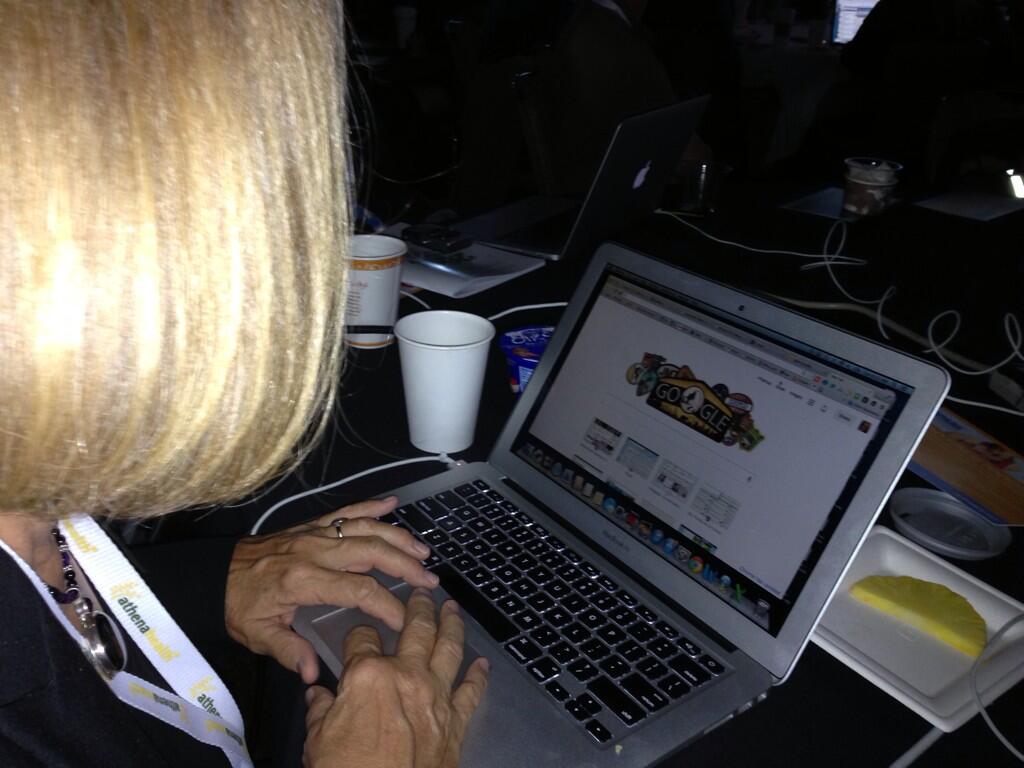
I had the privilege of watching her in action as she blended social media with the sessions at Health 2.0 and tweeted a picture of her in action


We spent some time afterwards talking about innovation in HealthIT and documentation on subjects as wide and varied as Florence and INtelligent assistants through Speech Recognition and Natural Language Processing (NLP) or Clinical Language Understanding (CLU):


Wednesday, September 4, 2013

Science, Evidence and Clinical Practice

A recent article on the The Difference between Science and Technology in Birth on the AMA site demonstrates the challenges we still face in getting clicnal practice influenced by science and data. Studies and data may show the path for best clinical practice but as the authors note there are multiple instances of the clinical community - in this case the OBGYN - either knowingly or unknowingly failing to follow the best practices

For deliveries in the US evidence tells us that fetal monitoring in low risk pregnancies has a deleterious effect - yet it remains standard practice in most settings to place external scalp electrodes and intrauterine pressure catheters

Although we still see external continuous fetal monitoring employed in many low-risk pregnancies, “as a routine practice [it] does not decrease neonatal morbidity or mortality compared with intermittent auscultation…. Despite an absence of clinical trial evidence, it is standard practice in most settings to place internal scalp electrodes and intrauterine pressure catheters when there is concern for fetal well-being demonstrated on external monitoring” [3].


They list several other standard practices including

  • routing episitomy
  • Use of Doula's
  • Challenges with Epidurals

Reasons for these behaviors are varied but as the authors state:

Many well-intentioned obstetricians still employ technological interventions that are scientifically unsupported or that run counter to the evidence of what is safest for mother and child. They do so not because a well-informed pregnant woman has indicated that her values contradict what is scientifically supported, a situation that might justify a failure to follow the evidence. They do so out of tradition, fear, and the (false) assumption that doing something is usually better than doing nothing

Until we fix these basic issues there seems limited opportunity to implement intelligent medicine and real evidence or science based practices.


Thursday, November 15, 2012

Discussing the Future of Medicine and Randomized Trials with @EricTopol on Friday #Voiceofthedr

I am excited to be joined by one of the keynote speakers from HIMSS13 conference Dr Eric Topol - Author of
The Creative Destruction of Medicine: How the Digital Revolution Will Create Better Health Care and has been named in the list of the Top 100 Most Influential Physician Executive in Healthcare, 2012 by Modern Healthcare

We will be discussing amongst other things the challenge of clinical research as the speed of innovation in medicine accelerates. There is a better way as Dr Topol describes here: Get Rid of the Randomized Trial; Here's a Better Way

Historically we ran large scale trials that were blinded - in other words patients would either receive treatment or a placebo - neither they nor their treating clinicians would know which protocol they were on. At the end of the results the data would be analyzed and demonstrate either the positive benefit fo the treatment or not.

But what if giving the patient results in the death of patients - is it ethical to give a placebo when this results in the death of patents that could have benefitted from the treatment.

In the new style of trial we use surrogate markers for disease in a specific genetically similar group:

Researchers will be testing a drug that binds amyloid, a monoclonal antibody, in just [300][1] family members. They're not following these patients out to the point of where they get dementia. Instead, they are using surrogate markers to see whether or not the process of developing Alzheimer's can be blocked using this drug. This is an exciting way in which we can study treatments that can potentially prevent Alzheimer's in a very well-demarcated, very restricted population with a genetic defect, and then branch out to a much broader population of people who are at risk for Alzheimer's. These are the types of trials of the future and, in fact, it would be great if we could get rid of the randomization and the placebo-controlled era going forward.


But is it safe and how will we ascertain if drugs are truly effective - Join me on Friday at 2:30 ET on VoiceoftheDoctor when I will be talking about this with Dr Eric Topol

Join me on Friday at 2:30 ET on VoiceoftheDoctor
There are three ways to tune in:

• Stream the show live – click the Listen Live Now to launch our Internet radio player.


• You can also call in. A few minutes before our show starts, call in the following number:  Call: 1-559-546-1880; Enter participant code: 840521#


•  HealthcareNOWradio.com is now on iTunes Radio!  Stream the show live – you’ll find this station listed under News/Talk


Thursday, February 17, 2011

Dr Watson Takes on Healthcare

Watson Emerges Champion in Jeopardy

Watson emerged the Jeopardy Champion last night with a resounding $ 77,147, beating both competitors (Ken Jennings:$ 24,000 and Brad Rutter:$21,600) by over 300% ($53,147/$55,547).
2011-02-16WatsonWinningTotal.jpg
Hats off to Ken Jennings and Brad Rutter for taking on the challenge and doing such a great job
2011-02-16WatsonThreeScores.jpg

This was followed today with the joint Nuance/IBM Press Release: "IBM to Collaborate with Nuance to Apply IBM’s Watson Analytics Technology to Healthcare" (here on IBM and Nuance's site) that recognizes the tremendous value that Watson can bring to healthcare. Watson showed last night the major advances that have been made by IBM's “Deep Question Answering” (QA) research team:
the ability of a computer to understand natural human speech inquiries that pertain to a limitless range of topics, and to make informed judgments about requests
There was plenty of coverage as evidenced by the 15 Million hits in Google for the search (Jeopardy/Watson) with the vast majority highlighting Watson's superiority (Time Magazine: Winner, Dr Watson I presume, ZDNet: Watson's Next Adventure - Healthcare with Nuance, Information Week: IBM Nuance Envision Watson Helping Doctors, NY Times: Computer Wins on Jeopardy, Trivial It's Not andIBM Moving Watson Supercomputer Beyond 'Jeopardy' To Health-Care. Stephen Wolfram of Wolfram Alpha weighed in with this thoughtful post (Jeopardy IBM and Wolfram Alpha) comparing Watson and Wolfram Alpha and this more light hearted post If Google Played Jeopardy: Smartest Search Engine, But It’s No Ken Jennings where he challenged search engines with the simplified task of entering the same Jeopardy Clues

Google showed well
Leading them to suggest that
Either he’s (Ken Jennings) an immediate acquisition candidate in Mountain View and Redmond, or he should just start his own search engine and answer queries as they come in
There were other dissenters including this post Could Google Play Jeopardy Like IBM's Watson. Google has certainly cornered search and access of data but even if the data can be found with a google search and there are certainly some shared concepts in the search technologies I'm not sure that finding the data in a search page is the same as answering the question and really understanding the question. But the summary and analysis of Natural Langauge:
Natural Language Reality Check: The reality is that the technology that Watson demonstrates, while amazing in a game show, is overkill for what most people need. Those behind “natural language” search technologies have long trotted out sentences like the “Who’s in the pajamas” example above to demonstrate how “smart” their search tools are. And yet, most searches people do on search engines are only two or three words long.
Missed the mark and the analogy is flawed on several counts.  I would suggest that our interactions are deliberately simplified when we interact with Google - we work around the lack of understanding of the Google search engine. And while Watson may be overkill for "most people" the potential application in multiple areas dealing with ever increasing volumes of unstructured data it is healthcare that has been struggling with the challenge of overwhelming clinical knowledge and our inability to access and apply this at the time of care delivery. In this discussion on the possible healthcare applications of Wtason/DeepQA


Dr Herbert Chase (Professor of Clinical of Medicine at Columbia University) says:
For at least 30 years it has been impossible for a physician to master all the material to practice medicine at the highest level. Biomedical literature has doubled in size every seven years but patients want those facts at the doctors finger tips when they see him (the doctor)
It is this challenge of data that clinicians face every day as they attempt to deliver the best possible care to each and every patient at the time of the consultation and something their patients expect. Definitely not overkill for patients or doctors and given the Tsunami of medical knowledge and the challenge of sharing clinical data. DeepQA will add a new level of medical intelligence to support to clinicians is with the application of Natural Language Processing taken to a new level of understanding.

Back in June I talked about this technology and the potential for application in healthcare (NLP in Healthcare). In October Nuance announced our strategic partnership with IBM and I covered the news in this post: Clinical Documentation Challenges and then again building towards the Jeopardy challenge NLP in Healthcare Part 2 and most recently this week as part of the potential solution to the challenge of shareable clinical data and clinical data models (The PCAST Opportunity, HL7 CDA, UEL and SAGE)

The announcement today builds on a deep research and technology partnership that already exists in multiple areas between the companies. As one person pointed out in a note to me yesterday
"I cannot understand that Watson cannot 'hear' an opponents wrong answer. They text in the question and then Watson parses the english, algorithms swirl, etc. However, when an opponent speaks it cannot hear. So when a bad answer is spoken it is bound to repeat it.. "
That is part of the innovation and solutions that Nuance will contribute to the partnership which will also include the Clinical Language Understanding (CLU) Technology that will be used create new solutions that provide hospitals, physicians and caregivers access to critical and timely information expanding from recognizing what was said and parsing data to now understanding the intent and providing guidance. This will push us one step closer to intelligent medical analysis real time with the clinician to assist hospitals to utilize facts and knowledge as they migrate toward evidence-based and accountable care models:
Recognizing the tremendous value that Watson can bring to healthcare, Nuance and IBM have teamed to co-develop solutions that will transform vast amounts of clinical data into actionable information across the continuum of care. This endeavor is intended to unlock important medical knowledge and facts buried within huge volumes of data repositories, providing healthcare provider organizations, payers and individual physicians a new level of medical intelligence
It has been yet another exciting day in the world of healthcare technology


If you want to see the Jeopardy games you can watch them below
Part 1:

Part 2:

and Part 3:


And it is not just healthcare:

Sunday, January 30, 2011

EHRs and their Impact on Quality of Care

Headlines this week have provided much confusion in the march towards digitization of healthcare that were based on a Stanford study published in the Archives of Internal Medicine: Electronic Health Records and Clinical Decision Support Systems with a conclusion:
Our findings indicate no consistent association between EHRs and CDS and better quality. These results raise concerns about the ability of health information technology to fundamentally alter outpatient care quality.
Needless to say a strong negative claim from a leading institution attracted a lot fo coverage (Medscape, Reuters, Health Data Management, iHealthBeat,  DotMedNews, Bloomberg.....and the list goes on). The power of the internet and the instantaneous nature of the news allows these stories to rapidly disseminate.
In fact some of this will add fuel to the HR408 Act  Spending Reduction Act of 2011 (the text of this can be found here). It is a far reaching bill attempting to reign in spending to the tune of 2.5 Trillion and includes several elements focusing on repeal of Healthcare IT stimulus spending S:302 which focuses on repealing the HITECH funding and investment - there was a good analysis in Health Data Management GOP Bill Puts Meaningful Use, HITECH Act in Peril that highlights the murky nature of the impact of this legislation.
But the power of the internet works both ways and there are several great articles that apply a sound analytical view on the study and highlight the limitations of the study. In this piece Dr WIlliam Hersh; Electronic Health Records Do Not Impact the Quality of Healthcare takes a long hard look at the study adn as he points out
Like almost all science that gets reported in the general media, there is more to this study than what is described in the headlines and news reports. The study was published in a prestigious medical journal by two Stanford researchers. The implementation of the research methods they used appears to be sound.
But as he points out there are serious limitations to this type of study based on the type of study and the data resources, in particular the study "used a data source collected for other purposes and he highlighted the following limitations:
  1. A frequent challenge - the study looks at correlation, which does not mean causality
  2. The quality measures used did not provide enough insight into actual quality improvement (process measures vs outcome measures)
  3. No detail of the EHR's being used and if they had any decision support in place relative the the quality measures
  4. THe care assessed was individual episodes of care and improvements in actual quality occur over multiple episodes of care (the longitudinal medical record)
  5. Data analyzed was old (2005 - 2007) and in any field of technology including Healthcare Informatics this is old
  6. No indication of the training and skill set of the clinicians being assessed and success and failure fo EHR's goes far beyond the technology and is closely tied to implementation and training
And there was extensive discussion that pointed to other articles and studies highlighting the benefits and in particular emphasize how early we are in this process. I imagine that for several other key inventions there was a similar response:
  • The Electric light bulb
  • Telephone
This 'telephone' has too many shortcomings to be seriously considered as a means of communication. The device is inherently of no value to us.
Western Union Internal Memo: 1876
  • Automobile
  • Microprocessor
  • And even the internet and the world wide web
THis follow up piece by Clem McDonald: Clinical Decision Support and Rich Clinical Repositories: A Symbiotic Relationship that highlighted a range of other positive studies and identifies significant breakdown in the meta analysis that was carried out. As he states succinctly:
  • First, and most important, the current article tells us nothing about which CDS guidelines were implemented in the systems that they studied. Practices and EHRs vary considerably in the number and type of CDS rules that they implement, and we do not know whether the CDS rules implemented by the practicesthat participated in the surveys addressed any of the 20 quality indicators evaluated by Romano and Stafford.
  • Second, the current study and Garg and coauthors' review considered very different categories of guidelines. Most of the guidelines (60%) in Romano and Stafford's study concern medication use; none of them deals with immunizations or screening tests, which were the dominant subjects in the studies reviewed by Garg et al.3 Furthermore, in our experience, care providers are less willing to accept and act on automated reminders about initiating long-term drug therapy than about ordering a single test or an immunization.
  • The third difference is that the current study examined the outcome of a single visit, while most of the trials reviewed by Garg and colleagues observed the cumulative effect of the CDS system on a patient over many visits.
  • Finally, the data available from NAMCS/NHAMCS may be limited compared with what is contained in most of the EHRs used for Garg and coauthors' trials. For example, the NAMCS/NHAMCS instruments have roomto record only 8 medications, even though at least 17% of individuals older than 65 years take 10 or more medications.
The road to digitization of healthcare is long and filled with many ups and downs. This study adds the overall knowledge but should be taken in the context of what was studied and its contribution to guiding us down the correct path and not, as some would believe> halting the journey and returning to the dark ages of pen and paper.