Monday, November 4, 2013

Must we Move to ICD10 - Short Answer is Yes

The short answer is yes - but I hear occasional stories and push back from clinicians and sometimes other healthcare staff - is it worth the spend and investment. Why not just wait for ICD-11 (Check out the beta draft of ICD-11 here). Why not just use SNOMED CT

For the individual doctor taking care of the patients they often see no direct benefit from ICD-10….or from SNOMED CT, LOINC, RxNorm, APR-DRG’s, ICD-9, APC’s, HCC’s, etc. But in the healthcare continuum that requires more than a single patient to be cared for and whole populations to be considered we need evidence and data to manage populations that has enough detail that has kept up with the explosion of medical knowledge. Yes capturing the codes may be difficult but the good news is there is technology to help clinicians to capture it at the point of care - anywhere and offers realtime feedback to the doctor with the unique and innovative Computer Assisted Physician Documentation (CAPD). ICD-10 is no longer to be feared but should be embraced as a bright new future that will start to code information in sufficient detail that is more representative of the complex nature of patients and their clinical condition. No longer grouped together in broad categories that do not adequately take account of the complex cases offering a much more nuanced view of the severity of illness.

So what is the difference between the two systems and what makes ICD-10 the right choice? Some of this relates to terminology and classification - nicely explained here by Dr Peter Johnson explaining the SNOMED CT system. As he says
Classification system,
A classification scheme could be thought of as a collection of buckets into which a care provider throws a particular concept or record. And since there can only be one bucket into which a concept fits, the process of labeling the buckets often leads to catch-all terms like: ‘Disease X, unspecified’ or ‘Y, not elsewhere classified’. As a result, accurately classifying records is rightly seen by most care providers as a separate process from record creation and is typically carried out by specially trained coders who know how to apply the process.

Terminology System
..a terminology allows the user to specify precisely what they want to record. Specifically, a terminology doesn’t have any ‘not elsewhere classified’ bucket terms, but is designed to have the terms that a user needs to record what actually happened.

Which brings me to the problem with SNOMED CT as a replacement for ICD-XX - clearly described by Carl Natale’s in his post: Why SNOMED cannot replace the ICD-10-CM/PCS code sets. As Carl rightly points out:
Physicians are going to have to learn how to communicate with EHRs — which will be based upon SNOMED — to comply with Meaningful Use. So the transition to SNOMED-CT already is in the works.
We do need more specific documentation but as a colleague of mine has pointed out this is not the onerous task that it first appears to be - much of the data is already information we capture as part of a normal clinical interaction and the additional data requirement may only be one clinical element.
For the construct of an ICD-10 code we have 7 characters made up as follows
  • Section,
  • Body System,
  • Root Operation,
  • Body Part,
  • Approach,
  • Device,
  • Qualifier
In a single specialty building up the code is part of the natural clinical content that we capture when documenting the patent encounter. The clinicians should not be expected to construct the code but does need to include all the details to allow the coding to be completed accurately. For example:

Open reduction internal fixation distal phalanx right index finger with K wire
contains everything necessary to code this as
0PST04Z - which is made up of:

  • 0 - Medical Surgical
  • P - Upper Bones
  • S - Reposition
  • T - Finger Phalanx R
  • 0 - Open
  • 4 - Internal Fixation Device
  • Z - No Qualifier
As Carl points out
Basically, ICD-10 codes aren't the problem. It's the specificity of documentation that will be required one way or another. SNOMED should make it easier to document to the required specificity. It is then up to the EHR system to convert that data to ICD information. Hopefully the physicians won't know what level of ICD is being used. They will just need to know what needs to be recorded.
So what does this look like in the clinical setting - this video offers a peek into the new world of documentation and how Healthcare technology, Clinical Language Understanding and integrated solutions will start to ease the documentation burden, allowing clinicians to focus on care and the patient and not documentation coding


Friday, November 1, 2013

A Paper Towel as a Medical Record - Really! #safety #HealthIT #EHR #hcsm

I ran across this posting on Mark Hindle's Twitter account:
The picture is shocking:


This is not just a hand written note as a simple reminder...this paper towel addresses the Pharmacy and says
"Please dispense Colecalciferol 20,000 units"
And it appears the pharmacy or maybe the nurses have dispenses this as evidenced by the "tick" over the top.

The Institute of Medicine published several studies including:

1999: To Err is Human
2001: Crossing the Quality Chasm

And the Journal of the Royal Society of Medicine Published a study in 2006; Poor handwriting remains a significant problem in medicine that stated:
Leape and Berwick called handwritten medical notes a ‘dinosaur long overdue for extinction

Yet here we are in 2013 and not only do we still have hand written notes but they are written on a paper towel......I'm left


Tuesday, October 29, 2013

The Future of Healthcare as Seen Through the Eyes of @kpTotalHealth with @Tedeytan #HealthIT

I posted a piece that was published on FastCompany site at the end of last month:


It included a link to an original concept from the innovative Kaiser founder Dr Sidney R. Garfield


I shared this with my wife who is an accomplished midwife (she stopped counting her deliveries after she hit 1,000) and we both shared a laugh but as she pointed out - at the time it was a brilliant compromise between two competing interest:

On the one hand you have healthcare wanting to help mothers rest after giving birth
On the other hand you have mothers who's genes are screaming at them - be with your baby

In this particular instance the National Health Service (NHS) in England was ahead of its time, guided by an experienced and well respected cadre of midwives who promoted and encouraged rooming in of babies when they were born. We experienced this with our children but our youngest was born here in the United States and at the time it was a fight to stop the nurses from removing our daughter from the room

I had the privilege of visiting the Kaiser Total Health facility and spent an invigorating few hours with Dr Ted Eytan, Physician Director in the Kaiser Permanente Federation (@TedEytan and his blog)

He was kind enough to reply to my article in a tweet:
And the details even appeared in the wall of knowledge with the background that I captured here:


Ted shared a link to the original history
KP’s ‘Baby in the Drawer’ Helped Turn the Tide Back to Breastfeeding Babies after World War II Which tells the story of the driver on this innovation centered around better outcomes from keeping mothers and babies together:
Sidney R. Garfield he had read an interesting article about the now famous Yale University School of Medicine research experiments with rooming-in for mothers and babies
Kaiser Permanente has continued their continued innovation - Small Hospital, Big Idea which continues and contributes to their impressive growth:
An Impressive and consistent increase in Patients

All this is embodied in the Kaiser Total Health Center that brings together existing and new technology in innovative ways. Everything from the large screen introduction:


 Through to the handheld ultrasound device:

It includes patient education with the explosion of the obesity epidemics - captured in this video graphic


The mock up health room 
Mock up Patient Examination Room

and placed working technology in the reach of innovators, patients and clinicians

3-D Visualization for Patient Engagment on Medication
 and simple technology - but so important - two hand sets for one phone so patient and health care worker can both listen in to the same conversation with immediate availability for language translation (I'm willing to be we won't need a telephone for this simultaneous translation in the near future)

and the room and facility continues to be updated:

No doubt Ted who is is currently exploring the GoogleGlass Innovation (you can read about his exploration here in his blog "The USA #ThroughGlass") will be including some of his google glass experiences as they learn more about this innovation

I believe

Paper and manilla folders will become a thing of the past relegated to museums

this will be true and perhaps when I am lying in my hospital bed will look back at this age and think
Mostly, I know that someday, someone in my same CMIO and MD shoes will think how silly it was that doctors actually hand-typed patient notes

Friday, October 25, 2013

Want to See #Mobile #Health Success - Look to #Africa #mHealth

I've said it before - Africa like many of the under developed countries is exploding with great use cases for mHealth. This piece: Kenya Has Mobile Health App Fever tracks the explosion of #mHealth.
Promoted and supported by the Kenyan Medical Association and Shimba Technologies the latest release MedAfrica offer ready access to medical information and verifying clinicians in the field and even a tool to verify the authenticity of drugs.

With over 50% of banking done by mobile phone in Kenya they are clearly adopting the platform in large numbers (Kenya is rich in mobile phones, with 25 million subscribers; Africa has more than 600 million of them). Applying #mHealth to the slew of health problems is exciting and rewarding. The size of and range of health challenges is daunting:

Many Kenyans have serious health problems; for example, according to the World Health Organization, more than 30 percent of children under age five show stunted growth. At present, only 7,000 doctors serve a nation of 40 million people. 

All this out of a company that was founded by Stephen Kyalo and Keziah Mumo, with $100,000 in seed money from a European VC

Seen here Steve Mutinda Kyalo
And its not just Kenya:
Mobile health platforms are making a strong showing in other parts of Africa, too. In South Africa, efforts include platforms that give HIV-infected patients automated ways to receive health information and reminders about upcoming doctor visits. In Johannesburg, 10,000 people infected with HIV have taken on these SMS-based alerts, resulting in big declines in missed appointments.
In Ghana and Liberia, a group called Africa Aid is experiencing strong success with MDNet, a system that allows users to call or text doctors for free. Since its founding in 2008, 1,900 physicians in Ghana have logged more than a million calls to patients, the group says.

Having real impact with that funding - awesome

Nkosi Sikelel’ iAfrika


You can take the boy out of Africa, but you can't take Africa out of the boy

Tuesday, October 22, 2013

Interview from #Health2Con with @DocWeighsIn on #speechrecognition #HealthIT #NLP and beyond

Loved spending time with Dr Pat Salber (@DocWeighsIn) from the Health 2.0 conference that took place a couple of weeks ago

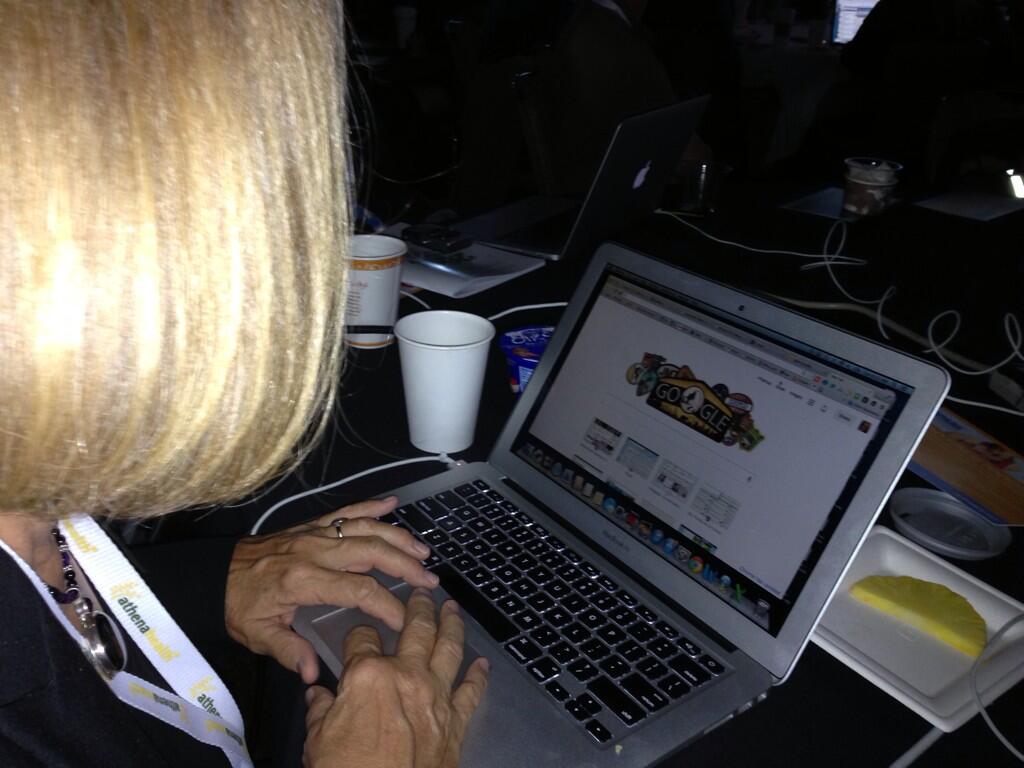
I had the privilege of watching her in action as she blended social media with the sessions at Health 2.0 and tweeted a picture of her in action


We spent some time afterwards talking about innovation in HealthIT and documentation on subjects as wide and varied as Florence and INtelligent assistants through Speech Recognition and Natural Language Processing (NLP) or Clinical Language Understanding (CLU):


Monday, October 14, 2013

If We can Build Smart Shelves to Sell more can we do the Same to be Healthier?


This company is building "smart shelves," to help them identify people and sell to them more directly targeted adverts and products....

new display units located by checkout counters, that will use sensor technology to identify the age and sex of the would-be snacker, analytics to determine what type of guilty pleasure best appeals and a video display to deliver custom advertisements. "Knowing that a consumer is showing interest in the product gives us the opportunity to engage with them in real-time," 

THis seems like ideal technology to use in a medical setting to help influence patient behavior for positive effect and perhaps even in the home to positively influence good healthy behavior?
 

Monday, October 7, 2013

Consumer Reports on Healthcare - Can #HealthIT Fix the Problems

Consumer reports published a Medical Gripes report What bugs you most about your doctor?
We asked 1,000 people about their biggest medical gripes recently

It included the chart "Grip-o-Meter"
What struck me was the number of elements that could be addressed using Healthcare Technology (HealthIT). While technology may not be a panacea it is a tool to help resolve problems, improve efficiency and ease communication and flow of information

For example - "Test Results not communicated fast". In the current day and age of instant communications, mobile phones and messaging why is it patients are left waiting hours, days sometimes weeks to receive a test result. There has been some push back by the medical profession on releasing results without allowing the doctor an opportunity to explain or contact the patient. IN one site they offer this compromise - test results are held for 24 hours maximum to offer the doctor a chance o reach out to the patient but if they have not the results are automatically released anyway.

Given the pressure of time and the challenges we face with resources and the too frequent occurrences of missed communication of results sometimes resulting in poor outcomes it would seem offering an automated results communication tool to all patients would be a simple step in improving satisfaction? If I can get an automated alert when my favorite team is playing, when the score is close capturing a cell phone number when we carry out a test and using this for outbound messaging seems like an obvious step and one that #HealthIT could play a role.

I bet others could see ideas based on the other "Gripes" - send me a note or leave a comment and I'll pull this together into a more detail post


Friday, September 20, 2013

Technology and Focusing on the Patient

Always enjoying talking with John Lynn (Founder of the HealthcareScene.com (he goes by @techguy and @ehrandhit) and great discussion yesterday on "Technology and Focusing on the Patient" using a Google Hangout


Tuesday, September 17, 2013

Hanging out with Congresswoman Marsha Blackburn & Dr Susan K Newbold at Summit of the Southeast

Hanging out with Congresswoman Marsha Blackburn & Dr Susan K Newbold at Summit of the Southeast #HealthIT


Susan K Newbold, PhD RN-BC FAAN FHIMSS CHTS-CP
Sknewbold@comcast.net, 443-562-0502 cell

Sent from my iPad

Friday, September 13, 2013

21 Bow Tie Salute to Farzad Mostashari

Like many in the healthcare IT industry, I was saddened by the announcement that Dr Farzad Mostashari (@Farzad_ONC) would be retiring. I would suggest as famed football legend Vince Lombardi said

"The strength of the group is the strength of the leaders"
And, for healthcare technology, Dr. Mostashari has been a great leader. I’ve outlined below some of the many contributions he has made to healthcare.

Dr. Mostashari joined the Office of the National Coordinator (ONC) in 2009, and has had a huge and positive impact on the implementation, development and overall perception of healthcare IT.  Personally impacted by the state of healthcare when his mother was admitted for arrhythmias, after having asked for the paper chart, he admitted;
I couldn’t even read the cardiology consult’s name
Perhaps this is one of the reasons he like me is a proud member of Regina Holliday (@ReginaHolliday) "Walking Gallery". This difficult, and highly personal, situation likely galvanized his vision as he took on the daunting tasks demanded by the role of the ONC. He inherited a department that had, in effect, been pushed over the edge of the luge and, whilst speeding wildly along this track, was expected steer a course that would deliver on a range of programs in record time:


  • Meaningful Use of Electronic Health Records (EHR)
  • Certification program for EHRs
  • National Standards
  • Grant programs
  • Regional Extension Centers
And that was just what he knew about coming in. The team endured the challenges, weathered the storm in the "Office of No Christmas"

He rapidly earned a reputation as a leader who listened and was engaged.  He made many appearances and, although he may not have been the first, he was certainly an early adopter of social media and online engagement – clear indicators of his heartfelt passion to be part of the solution. As a customer service representative I recently encountered very astutely pointed out:
I can't do anything about the past, but I can help improve the future


Successes
It is hard to pick individual highlights from such an impressive record, but here's my list of Dr. Mostashari’s top 13 achievements and quotable/notable moments from his time in office:

  1. Successfully delivering on the Stage 1 Meaningful Use, despite frustrations and the challenges of a fickle and change-resistant healthcare profession.  He gracefully offered a personal hand to help steer his colleagues:
    "Meaningful use is the best-we-could-make-it roadmap to prepare for delivery of higher quality care and mitigating some of the costs toward getting there, if it's a distraction we need to change it, and I want to hear from you personally."
  2. Creating a viable technical assistance program that has touched many providers and hospitals through regional extension centers (REC).
  3. Driving the successful adoption of electronic health records (EHRs) and electronic medical records (EMRs).
  4. Interoperability (see note below on focus for the future)
  5. Pushing for patient empowerment (He, like me, is a proud owner and runway model for the Regina Holliday Healthcare Collection).
  6. As he said: "We’re on the right track to make meaningful use of meaningful use
  7. ePrescribing
  8. And as if to prove the point about his use of social media, this from his twitter feed: “We've made more progress with EHRs in the past 2 years then we have in 20"   
  9. Championing the patient engagement he stated: "We cannot have it be profitable to hoard patient information"
  10. Nailing the coffin shut on paper he said: "Once you close a paper file it's dead. You’re not able to move it or learn from it"
  11. While this may not be his own personal quote but he applied cyberpunk science fiction, William F. Gibson famous quote to healthcare: “The future is already here – it’s just not evenly distributed.” by pointing out that we do have the technology - its just not being applied
  12. Piloting Meaningful Use stage 2 criteria, which built on the success of stage 1, and pushed towards interoperability including standards for data sharing data, quality improvement, and quality measures that foster  patent engagement. As he put it: "We are using every lever at our disposal to increase the sharing of information" and "Patients need to care for themselves and become partners in their care"
  13. Successfully weathering the storm of the controversial (or as he put it "headline grabbing") Health Affairs article based on data from 2008 that suggested that EHR technology was increasing the costs of healthcare.


The Future:
To the lucky individual taking the reins, I offer five suggested  areas of focus:

2. A friend once said to me: "You've put us on the horse, you might as well give us the ride." The same can be said of payment reform, which must shift from quantity-based to quality-based payment. And taking a sheet from Dr Mostashari's play book, every journey starts with a single, small action, so even a small dent would be a welcome shift.


  1. Continue the engaged and inclusive discussion with all the constituents and make social media a central part of that strategy both for ONC but also for the healthcare industry.
  2. A friend once said to me: "You've put us on the horse, you might as well give us the ride" The same can be said of payment reform, which must shift from quantity-based to quality-based payment. And taking a sheet from Dr Mostashari's play book, every journey starts with a single, small action, so even a small dent would be a welcome shift.
  3. I must include a shout out for patient engagement. Nowhere else in the industry will you find such a large and untapped resource that is ready, willing – but perhaps not yet able to participate in the change. As I have stated many times:  when a doctor and patient are in a room, there is nobody, I repeat nobody, more interested in successful outcomes than the patient. Give them the tools and make them part of the solution.
  4. Occasionally, the issue of Tort and Medical Negligence is raised, but it appears to have the "third rail" syndrome. Unless this is addressed, we will continue to see "defensive medicine" practiced. As I recently blogged in Science, Evidence and Clinical Practice, despite clear data that shows intensive monitoring causes more harm in normal care deliveries, we continue to see almost universal rates of this high-level monitoring.  While some may be attributable to the payment system, I believe a large part of this volume stems from the general inertia of and fear of litigation.
  5. Above all - have fun. I made this point at every soccer practice when I was a coach. If you aren't having fun, there is little incentive to do well or, for that matter, to do at all. I know I am constantly amazed at the great fortune that finds me at this intersection of medicine and technology. I constantly have that feeling as if I paddled for the wave just at the right time:
"Surf's Up dude - ten foot waves of the Pier"


The Making of the 21 Bow Tie Salute

Dr Farzad Mostashari has been an incredible role model, a source of inspiration and a true visionary who has helped others see what the future of healthcare can look like. And so, in extreme appreciation of all that he has accomplished, I offer this 21 Bow Tie Salute.  


I was fortunate enough to have another wonderful role model, my father, take the time to teach me how to tie a bow tie, but for those of you wanting to learn the fine craft of tying a bow tie, instructions are included below (The 21 Bow Tie Salute was made with Real Bow Ties). 


Thanks Dad!

Here are some basic instructions:


News and sources include:


Wednesday, September 4, 2013

Science, Evidence and Clinical Practice

A recent article on the The Difference between Science and Technology in Birth on the AMA site demonstrates the challenges we still face in getting clicnal practice influenced by science and data. Studies and data may show the path for best clinical practice but as the authors note there are multiple instances of the clinical community - in this case the OBGYN - either knowingly or unknowingly failing to follow the best practices

For deliveries in the US evidence tells us that fetal monitoring in low risk pregnancies has a deleterious effect - yet it remains standard practice in most settings to place external scalp electrodes and intrauterine pressure catheters

Although we still see external continuous fetal monitoring employed in many low-risk pregnancies, “as a routine practice [it] does not decrease neonatal morbidity or mortality compared with intermittent auscultation…. Despite an absence of clinical trial evidence, it is standard practice in most settings to place internal scalp electrodes and intrauterine pressure catheters when there is concern for fetal well-being demonstrated on external monitoring” [3].


They list several other standard practices including

  • routing episitomy
  • Use of Doula's
  • Challenges with Epidurals

Reasons for these behaviors are varied but as the authors state:

Many well-intentioned obstetricians still employ technological interventions that are scientifically unsupported or that run counter to the evidence of what is safest for mother and child. They do so not because a well-informed pregnant woman has indicated that her values contradict what is scientifically supported, a situation that might justify a failure to follow the evidence. They do so out of tradition, fear, and the (false) assumption that doing something is usually better than doing nothing

Until we fix these basic issues there seems limited opportunity to implement intelligent medicine and real evidence or science based practices.


Thursday, August 22, 2013

Introverts and Extroverts and How to Deal with them

In a great piece on FastCompany titled: Are you an Introvert or an Extrovert? What it Means for your Career, Beth Belle Cooper explores what she considered a binary position or bucket to put people in but discovers this is really a continuum and one that we as individuals don't sit at one spot all of the time

As she describes - it is an Ambivert Personality Scale Continuum


An important aspect to healthcare in our interaction with the ever expanding teams that contain wide variations of individuals

But in thinking about work, health acre and interactions the 12 tips for dealing with the different groups seemed like great advice all round

12 Tips for Dealign with Introvert
  • Respect their need for privacy
  • Never embarrass them in public
  • Let them observe first in new situations
  • Give them time to think don't demand instant answers
  • Give them advanced notice of expected changes in their lives
  • Give them 15 minute warning to finish what they are doing
  • Reprimand them privately
  • Teach them new skills privately
  • Enable them to find one best friend who has similar interests and abilities
  • Don't push them to make lots of friends
  • Respect their introversion and don't try and make them into extroverts


10 Tips for Dealing with Extrovert


  • Respect their independance
  • Compliment them in hte company of others
  • Accept or encourage their enthusiasm
  • Allow them to explore and talk things out
  • Thoughtfully surprise them
  • Understand when they are Busy
  • Let them Dive Right in
  • Offer them Options
  • Make physical and verbal gestures of Affection
  • Let them Shine
I think what's interesting is most of us are in both camps at different times - the two lists seem like great advice all round

Monday, August 12, 2013

Technology as an Aid vs Hinderance to Doctors

A recent article in Becker Hospital Review:  Technology Should Aid Human Interaction: Q&A with Dr. Nick Terheyden, CMIO of Nuance featured some important points to make


Health IT needs to fade into the background. It needs to become part of the fabric of the office rather than the focal point, and then the interaction will change
  • Using the tools to allow the clinician to focus on the patient not the technology
  • Human beings deal in narrative and stories, patients want to tell their story and clinicians need the richness of the narrative to help guide medical decision making
  • Remove the Physical Barriers to the clinicians patient interaction
  • Healthcare is not the focus - the patient is

The key to our future and to the successful use of health IT will be turning the focus back on patient and the physician.

Thursday, August 8, 2013

Interview with HealthTech Vision

I had the pleasure of speaking with Alex Welz of Health Tech Vision last week and he posted the interview here - or you can listen to it below

The importance of bringing intelligent voice interactions to Health IT especially as medical technology moves to into the Mobile world. It is an exciting time with technology offering real hope


Wednesday, July 31, 2013

Presenting at Health2.0

See me at Health 2.0” src=Excited to be presenting at Health2.0


There have been exciting innovations in Cloud based Intelligent Speech Understanding and our new development tool set is offering a way to help healthcare providers transform patient stories into high-value clinically actionable medical information. No more burdening clinicians with data entry tasks.

See me at Health 2.0” src=Florence

You can see it here integrated by by Sense.ly

We have a mobile development platform with more than 750 developers signed up already

The mobile health platform is good at delivering information but the interface can be challenging and capturing the medical decision making difficult using on screen keyboards and point and click methodology.

Mobile speech enablement offers tools that facilitate the navigation and human device interaction and includes capture and clinical understanding services that turn narrative into discreet actionable data to capture the clinical decision making

You can see a brief demo here:


Hope to see you at Health 2.0

Monday, July 29, 2013

Running out of Time

All truly great thoughts are conceived by walking
Friedrich Nietzsche


Don't walk behind me; I may not lead. Don't walk in front of me; I may not follow. Just walk beside me and be my friend
Albert Camus

I met Regina Holliday a while back at one of the many conferences that she attends:


At this conference she was there to present and was also creating a painting. Her reputation had preceded her and I was excited to meet her in person and hear her story first hand. I had seen some jackets at conferences and had discovered the story behind the Walking Gallery. An idea that came from a tragic story in a healthcare system that is broken


Back in 2011 a video was made featuring many from the gallery filmed at the Kaiser Permanente Total Health Center:


The Walking Gallery from Eidolon Films on Vimeo.

You can see her presentation on Slideshare here:

But there is nothing that could match the power of hearing this in person.

Regina offered to paint my story and it was months before I could pull together some photographs and sit down to articulate my personal journey in healthcare but that all came together a few weeks ago, almost in time for another walking gallery gathering. With so much going on Regina knew what she was going to paint but had not (as the picture shows)
 managed to download it quite yet

My journey to medical school and joining an honorable and privileged profession started when I was still at school and I remember the seminal moment that made me realize this was the pathway I wanted to take:


I was visiting my older brother in London we exited from Victoria rail station just as somebody had been run over by a bus. I watched as my brother pushed his way to the front of the crowd and he stooped own while very one watched - he was a doctor and knew what to do. As I stood on the sidelines watching I realized that I want to be doing rather than watching


I was a very young medical student and while I enjoyed medical school there was no doubting the fact that I was dealing with something that was really quite unique and challenging emotionally. Life and death was part of normal clinical activities and shortly after my 22 birthday I graduated


I have been heard to joke that the TV Series Doogie Howser was modeled on me as that was some years later - he was also the original blogger.


My Story
Running Out of Time


Practicing medicine in the United Kingdom in the national health service which while delivering great care placed an enormous burden on the people delivering that care. The environment was challenging, especially for a young junior doctor and I found myself questioning what I'd let myself in for. My first clinical job I worked 132 hours per week, I had Tuesday and Thursday evening off. At the time, that was the norm and all of my colleagues had the same work schedule as I did and I noticed that my senior colleagues not only had that working schedule but also took on more clinical responsibility. My weekends were hellacious, waking up on Friday morning and not finishing until Monday evening. I shared the work with a colleague and friend by the name of Niamh Anson. We would share the on-call work and split the activities, with one of us covering wards and the other covering the emergency department admissions.

The constant and chronic sleep deprivation took its toll and I repeatedly questioned the job I was doing and indeed whether I was even safe. The nurses proved to be our saving grace and several occasions when we made mistakes through simple tiredness they caught these mistakes and quietly corrected or prevented our errors. I don't remember a single time of being on call when I wasn't up most of the night and typically at leas every hour. Rarely did this not require a visit to either the ward or the emergency department. Many the time, I would walk from my living quarters to the emergency department angry at the system that would place such a burden on anyone and wondering if there was something wrong with me.

On one particular day my two team members were not at the hospital. Niamh was on holiday, one which had been booked many weeks ago but as is normally the case medical staffing had failed as usual to find replacement. By two in the afternoon, the emergency department had 17 patients waiting to be seen by me, there was a patient in intensive care on a ventilator that was having problems, and the cardiac care unit had a patient that was having a lignocaine reaction. I reached breaking point and called medical staffing, and told them I was quitting. Their reaction, humorous in hindsight but at the time not, was to tell me that my contract did not allow for me to quit. Fortunately the ward sister from the cardiac care unit intervened and quietly called my two attending's. The next thing I knew I received a call from one of them asking me to meet him in the emergency department. I thought my career was over and proceeded down to meet him expecting to be blasted and read the riot act. I was pleasantly surprised to find my two consultants there stuck into seeing patients and helping me out. One of them admitted all of the patients in the ED department while the other dealt with the patient on the intensive care unit in the coronary care unit.

Between us we were able to triage and treat all the patients by the end of the afternoon. Even now as I think back to that story I still find myself quite emotional about the experience and support from two outstanding individuals. They rounded it out by insisting that we went to the local pub for a drink (non-alcholic of course) and listened to me and provided counsel and support.

Sadly they were not typical of the senior staff in the health system and most took the view that they had suffered this level of overwork and therefore everybody else should experience the same. This was a recurring theme throughout my time as a clinician and I found most disturbing and many times very depressing.


If I am walking with two other men, each of them will serve as my teacher. I will pick out the good points of the one and imitate them, and the bad points of the other and correct them in myself.
Confucius

I remember vividly one instance where the attending surgeon I was working for heard that I was taking a sabbatical and thinking about leaving medicine. He started by saying that I was terrible shame, and I thought he was about to offer some guidance/support and thoughts about where the system is wrong and how I might cope with it. Sadly he proved to be similar to many of his colleagues and peers and felt that the system was wrong in allowing me into medical school. The system should of been better at weeding me out since there was clearly something wrong with me not with the system. He like many of his peers believed the baptism by fire, sleep deprivation and the general demeaning of junior doctors was an essential part of training and character building. As he put it, he had experienced this in his junior doctor days and he'd survived and done fine. What he failed to appreciate was that at the time he was practicing as a junior doctor, emergency call was typically a Porter coming to his door knocking on his door to tell him that somebody was "going off" and leaving a cup of tea for him. He would dress himself, drink his tea and proceed to the ward, where the patient had either died or survived, but there was very little that he could do to influence the outcome. My experience consisted of being surgically attached to an emergency page that would bark out at me at all hours, telling me to go to a ward or location in the hospital for an emergency resuscitation the could take anywhere from five – 60 minutes.

There is no easy walk to freedom anywhere, and many of us will have to pass through the valley of the shadow of death again and again before we reach the mountaintop of our desires
Nelson Mandela

My friend and colleague Niamh Anson
had many of the same experiences and like several of my colleagues elected to move away from the system leaving the NHS for Australia, perhaps hoping that this system would be more bearable. Sadly some years later she committed suicide as too many of my colleagues and friends do.

So my Walking Gallery Jacket:


As Regina described the picture:

The sky represents the never ending shifts as does the hour glass. The medical students and doctors are all standing beside me, also exhausted. My friend and colleague Niamh Anson jumping off the hour glass due to stress....


In what can only be described as a "stroke of luck" the painting of my jacket was caught on Fox 5 News doing a piece on the Walking Gallery (right around 00:24 -> 00:50 and around 01:28):

DC News Weather Sports FOX 5 DC WTTG
Or if the vide does not appear you can click this link


My jacket coming at number 227 - I hope we get all of these together one day.

If you don't like the road you're walking, start paving another one.
Dolly Parton

Like everyone else - I too have an oath to wear my jacket and use it as a tool to spread the word and effect change:

No one saves us but ourselves. No one can and no one may. We ourselves must walk the path
Buddha


Thursday, June 27, 2013

7 Predictions for the Future of HealthIT

Great post: 7 predictions for the future of health care technology
I expect we are failing to imagine all the other opportunities that exist but makes some key points
Democratization of Medical Knowledge

For thousands of years, the science and art of medicine has been passed down from generation to generation under an apprenticeship model (it's called "a practice" after all). Today, we have an opportunity to leverage technology to make doctors' wisdom accessible to all. To date, we've published entire encyclopedias of medical knowledge, but they remain largely impenetrable by the mass audience. What's missing is useful, user-friendly information that guides healthy behavior

Quite right - gone are the days of the all wise and knowledgeable oracle ala "Wizard of Oz" for doctors

Consolidated Patient Information
It's only a matter of time before a platform emerges that can aggregate and safely store patient information in one place.
Not sure I agree that we are that close - we need truly shareable data but we continue to struggle to reach this key goal


Cost Savings from HealthIT
You bet!

we will need an efficient system to triage health queries and manage patients based on urgency, severity, and available capacity

And we will (and are) getting that! This company Sense.ly is a good example and leading this charge with virtual assistant technology

Medical Knowledge is Exploding

And it is only going to get worse (or should that be better) - its not just #bigdata that is driving this but the explosion of understanding, technological advances (genome, biome to mention a couple)

Focusing on the Patient
I have been saying this for a while - and Health technology is offering some new concepts to allow clinicians to focus on the patient vs the technology

The average doctor-patient encounter in the U.S. lasts seven minutes…..not surprisingly, patients often complain about their doctors' bedside manner

As this company EZDerm has shown with their innovative application has shown (what a great advert)


Technology can actually help foster a stronger culture of care in a fast-paced world – when visits are more efficient, doctors have more time to hold a hand, share a smile, alleviate anxiety, and talk with each patient…..Making patients healthier and happier


Monday, June 17, 2013

Original Geneticist who discovered BRCA1 Gene - Delighted with #SCOTUS ruling

The Geneticist Mary-Claire King who discovered the BRCA1 gene, says

she is delighted by the U.S. Supreme Court ruling that makes it illegal to patent it

and rightly so

Dan Munro reviews the decision in this piece on breaking the Myriad Monopoly
and he rightly pointed out that Mark Skolnick said in an interview in 2007

Q: "You [Myriad] said this test will one day be 100's of dollars. Why is it still $3,000? Why is it increasing?" Joanna Rudnick – film documentarian

A: "That's a good question and I think there's a point at which we have to start looking at decreasing the cost of the test." Founder and Former Myriad Genetics CEO – Mark Skolnick

Hmmm - now 6 years on and instead the price increases?

I don't think this will stifle innovation and what is often forgotten is much of the discovery and innovation was publicly funded - the original DNA project was publicly funded. This is a win for science

Wednesday, June 5, 2013

Hybrid Workflows Big Source of Errors for EMRs

Interesting study published by Pennsylvania Safety Authority 

What will not be a shock but still an important finding - hybrid workflows major challenge in EMR implementations creating much increased risk of errors