In the Spirit of helping those that face the digital tidal wave of technology in healthcare with trepidation I offer the following top ten reasons why this will be a good thing and include some thoughts on easing the transition from current methods to a digitized clinical office
1) Ready Access for Everyone
Paper medical records cause harm and in multiple studies have been shown to fail to deliver the necessary information to all the clinicians involved in care. In a study I quoted some years ago done by then Arthur Anderson they found that in less than half of patients cases the relevant clinical notes were neither available or could be found at the time the patient was seen. Digital records are available to everyone involved in the care of the team who has access. Instant availability provides referring physicians and specialists as well as the patients with a copy of medical record quickly and conveniently.
2) Digital Record are More Easily Kept Up To Date
New innovations and digitization allows for the capture of information by the patient prior to a visit. Almost every clinical facility asks patients to fill in forms as they sit in a waiting room – the information contained in these forms is marginal at best and locked away on a piece of paper. From a patient perspective the information has likely been provided to multiple other offices and clinical providers. Digital records are on the pathway to effective and meaningful sharing of clinical data that will remove the need to render or re capture the same information. Focusing on capturing it once and allowing the patient to review it for correctness and completeness at the time of the visit is likely to lead to a much higher quality more accurate medical record. It may seem foreign to many clinicians but the patient probably has the biggest vested interest in an accurate and complete medical record more so than anyone else involved in the clinical care process. In some cases the digital record can be shared with the patient ahead of time online in a secure environment and they can check, update and complete this before arriving for their appointment.
3) Filtering and presentation
Clinical information captured as data throughout the continuum of care can be presented in innovative and more useful ways ("Can Electronic Clinical Documentation Help Prevent Diagnostic Errors"; N Engl J Med 362;12 March 25, 2010 pdf).
Seeing a single blood pressure reading adds little to the clinical decision-making process. Seeing the blood pressure plotted over time with a clear upward trend is far more useful in identifying hypertension that requires treatment.
4) No Need to Loose the Narrative
Capturing the whole story remains an essential component of any clinical record with the history contributing anywhere up to 80% of the final diagnosis. As part of any move to the digital medical record the inclusion of this narrative and the ability to record it without interfering with the normal workflow is a must. EHR’s have a wide range of tools and techniques for capturing and recording the patient record and there is wide variation in their use. Different specialties have different needs – in ophthalmology there are many data points routinely collected and form filling on a computer or digital tablet is likely to be efficient. General medicine on the other hand is dependant on the narrative and the detail behind the symptom. In this case it is important to provide tools to capture the data efficiently without adding to the time required for documentation. Historically these notes were hand written which probably induced an element of brevity. Hand written notes were replaced by dictation and transcription which while efficient for the clinicians introduced delays in the availability of information to the referring physician and other clinicians and proved costly. Recent moves introduced templates and forms along with tools to create these notes and while they work in some cases there are disadvantages of losing the patient story, and the inability to convey the meaning (“The transition from paper to electronic inpatient physician notes”; J Am Med Infom Assoc 2010; 17:108-111 abstract). Speech remains the most common means of communication and providing tools to capture the clinical story and convert that into a digital record have been successful in many settings (Fallon clinic Study). The key to success is offering a progressive blend of tools and methods to accommodate individual preferences and situational constraints. No one method suits all circumstances and all individuals and providing choice is the key to success. Present a choice and allow regular dictation and transcription while offering a pathway to more structured data entry, either through computer based forms entry or using speech recognition dictating directly into the EMR. (Save the clinical narrative)
5) Creating Structure and Data
If the narrative forms is an essential part of any clinical record so is structured data but generating both elements remains a challenging prospect for the busy clinician. New technologies on the horizon will automatically process the narrative and extract data elements to be placed directly into fields within an EMR. Using clinical language understanding (CLU) in conjunction with speech recognition technologies allows the clinician to document a succinct evaluation and description while automatically producing a discrete and codified problem list among other key clinical values. Codification renders this data useful to the EMR making it semantically interoperable. This forms the basis of the decision support, evidence based medicine and the error catching for ePrescribing solutions that have built in databases of contra indications based on specific clinical conditions (an allergy for instance) or careful monitoring and adjustment of doses based on renal function test (Gentamicin for example needs careful monitoring of renal function to prevent hearing damage)
6) Practical Clinical Support Tools
Human memory alone cannot guarantee the right questions and clinical information is gathered and applied to arrive at the most likely differential diagnosis. The landscape of clinical knowledge is rapidly changing and becoming more complex. Doctors need approximately 2 million pieces of information to practice medicine and subscribe to an average of 7 journals representing approximately 2,500 articles per year that they must read, process and then apply in order to stay current – an all but impossible task that is only getting harder (Sackett DL: Surveys of self-reported reading times of consultants in Oxford, Birmingham, Milton-Keynes, Bristol, Leicester, and Glasgow, 1995. In Rosenberg WMC, Richardson WS, Haynes RB, Sackett DL. Evidence-Based Medicine. London: Churchill -Livingstone). Digital records are the basis for applying knowledge and providing decision support to busy clinicians. While these alerts and tools are still in their nascent form, many are far to intrusive and can be triggered too easily. Refinement of these tools will bring about better quality of care helping prevent errors and facilitating informed decision making for patients and clinicians.
7) ePrescribing – The Key to Safer More Efficient Prescribing
Electronic prescribing appears to reduce the rate of medication errors and should be an integral part of any clinical system. While the process of entering a prescription can seem arduous initially efficiency is rapidly achieved through frequent use and user customized and system stored favorites and pre populated prescriptions can ease this pain. Add to that the value of legible prescriptions that are almost instantly available to pharmacies and help the patient and the pharmacist and clinicians deliver the right drug with the right dose to the right patient at the right time. And built in to the prescribing system are contra indications, allergies and drug-drug interactions that can be caught as part of the prescribing activity, reducing medication errors and improving the quality of care.
8) Timely and Failsafe Communications
Computers are good at repetitive tasks and once programmed never forget. Tracking results, tests and clinical findings and ensuring that urgent communications reach the intended recipient every time is easier using a digital record. Much of our personal lives are now organized using mobile hand held devices that include calendars, automatic alerts and alarms, so could be our digital medical record. I receive notification from my bank when an unusual transaction exceeding a specific amount is authorized from my credit card. A digital record can identify unusual or abnormal results and highlight the information to the clinical team including communicating the information to the patient. Even with the best intentions paper based communication can and do break down. There are many examples a condition being identified correctly but a breakdown in communication to the patient or the correct caregiver may have led to an unfortunate, but potentially avoidable consequences.
9) Security
While much has been made of security issues associated with digital medical records the reality is that medical records than the old paper records. Furthermore access is easily tracked and audited. Ensuring the right level of security is essential. There has been many stories of paper records that frequently “walked” out of hospitals, clinics and into the back of cars, offices and even dumpsters.
10) Mobility and Portability
We live in a rapidly changing world and recent natural disasters have demonstrated the need for mobility and portability. Hurricane Katrina demonstrated the need to create medical records that are available in more than one location and are effectively backed up. There were few patients affected by Hurricane Katrina that were able to leave the area and attend another facilities and receive care without significant interruption. For example Veterans who fled the area almost instantly had their medical records available in other VA hospitals. While this might be an extreme example of crisis mobility and extraordinary circumstances our population and society is far more mobile than ever before. People no longer live their entire life in the same location. In addition to facilitating mobility, digital records deliver built in redundancies and create backups and copies to ensure survivability of information. But mobility is not just about the record but the ability of the clinician to access the record from any location and at any time. Seeing patients out of hours has always been difficult with the lack of available information – digital records that are accessible from any location and even on portable devices can provide instant access to key data to help clinicians manage patients efficiently. Reviewing a medical record on a mobile phone may not be ideal but having access to information even on a small screen is preferable to having no information as the basis of clinical decisions on patient care.
Digitizing medical records is not so much a destination but a journey and one that we must all take. There are challenges but the benefits are clear. The question you must ask yourself as a physician is can you afford not to go digital and more importantly can your patients.
Tuesday, August 24, 2010
Average wait time in ED 4 hours
Average wait time for "emergency" treatment is in excess of 4 hours. As the article puts it: Fast Treatment Rare in Emergency Departments
>>enough time to watch 4 episodes of the TV series ER!
Actually more like 6 if you removed the adverts
A sorry state of affairs that reflects the strain on the service and a high degree of inappropriate use driven by financial pressures, uncertainty and ignorance
There must be big savings to be had in focusing on this problem, creating better low cost (or free) alternatives, and including some push to stop unnecessary usage.
Sledding injuries can be severe
It is probably no great surprise that sledding injuries occur in children but the severity especially in children under 4 years of age tends to be more severe and more likely to be a head injury. The commonest injury across all groups was fractures followed by contusions and abrasions Sledding Injuries Common in Kids, Can Be Severe (CME/CE)
It may seem a long way off as we sit in the heat of the summer but it will be sledding season soon
Oil spill clean up workers likely to experience more healt problems
Previous spill clean ups show increased health problems in the workers including respiratory problems and even some chromosomal changes
Oil Spill Clean-Up Tied to Adverse Health Effects (CME/CE)
Tuesday, August 17, 2010
Brain Trauma Can Mimic Lou Gehrig’s Disease
Fascinating study released suggesting that ALS (commonly known as Lou Gehrig's disease) is mis diagnosed in many athletes suffering head trauma and concussion as well as military veterans: >>Study Says Brain Trauma Can Mimic Lou Gehrig’s Disease:
A new study suggests that concussions and head trauma can cause degenerative diseases similar to A.L.S. and that Lou Gehrig may not have had Lou Gehrig’s disease.
http://nyti.ms/c6Y9Xs
Aside from the important emphasis on the significance of brain trauma that is occurring in our athletes in particular our younger athletes there is some interesting analysis of the etiology and process that seems linked to proteins produced as a result of the trauma that persist and travel in the nervous system to cause further permanent damage. Unfortunately despite significant advances even this progress begs even more questions regarding the brains function and more importantly how to protect it and limit damage. This will be interesting research to watch and especially important for our youth sports Programs.
Monday, August 16, 2010
Would you like a statin with that Burger
Perhaps a better strategy might be not eating the burger and shake rather than offering packets of Statins to go with excess fat and food intake:
A Burger, Shake, and Some Statins
But practical challenges seem to prevent our ever increasingly over weight society from moderating input so this could prove to be a practical approach that works. You might even find food manufacturers and restaurant offering to add it to food for you. In some respects this is similar to the addition of the anti dote to overdose of acetaminophen (Tylenol) that is available and would prevent liver damage in the case of over dosage. But like this concept statins may suffer the same challenge - economics. While most recognize the value of extra safety of adding the antidote to Acetaminophen this version has limited sales as it costs more and cannot compete with cheaper version that don't contain the antidote. Adding statins will likely be an economic issue not to mention the side effects that accompany statin therapy
Would you take food with statins for prevention?
FDA Warning on Fake Tourniquets
In what is likely to be a troubling problem that will likely occur with increasing frequency the FDA has warned that there are a number of counterfeit copies of military-grade tourniquets which may either break or fail to function as well as the original. FDA Warns Consumers of Fake Tourniquets
These are devices to designed to restrict the blood flow on limbs in urgent and elective situations.
Fakes of the emergency medical device have a weak plastic tension rod that may bend or break before adequate therapy is applied, FDA tests of the counterfeit found. The lack of pressure may not sufficiently stop blood flow and may cause excessive blood loss in patients.Hard to identify fakes although sourcing from approved suppliers and looking for "National Supply Number on the product's C-A-T logo its side, NSN6515-01-521-7676" might help. I suspect this will be a recurring problem with many other devices and products. The challenge with these fakes is that unlike fake rolex these fakes coudl cause significant harm, even death.
Thursday, August 12, 2010
Nuance Medical Search Application Now Available
Nuance released their latest offering for the iPhone today (as previewed at HIMSS 2010)- it was reviewed in several journals including
AppAdvice: Dragon Search Goes Medical with a favorable review
PubSearchPlus from deathraypizza! that provides an iPhone search front end to PubMed
Medical Search from Intelligentmobiles - designed to help find medical practitioners nearby
and some medical code search apps
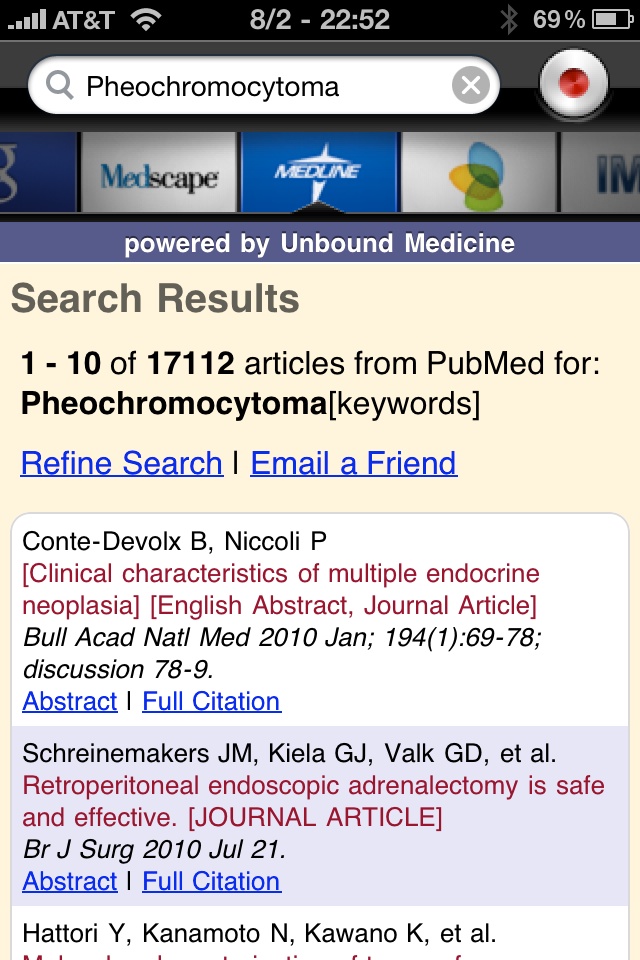
The principle and idea is simple - tap to dictate the search term and automatically submit this to several popular medical sources:
Each of these search tabs appears in a slider across the top and offers a quick look at the search results for each of the medical sources. So for example - searching for "Pheochromocytoma" and results are displayed for each of the tabs:
IMO
Medline:
Medscape
As with many iPhone apps the individual links can be viewed directly on the screen and opened in the iPhone Safari browser. You can read more on the Nuance web site here and watch a video demo here.
Go ahead - give it a try and download it from the iTunes store now and let me know what you think
AppAdvice: Dragon Search Goes Medical with a favorable review
Once again, Nuance Communications has another excellent app on their hands, although this one is much more narrowly tailored. But if you’re working in the medicinal field and want something to aid you on-the-fly with great speech recognition, then this is definitely a great choice. It’s simply a great pocket companion for you while on the job in case you need to reference something or get a refresher on a conditionYou can download the App in iTunes here its free and in the same genre as some other medical search applications that include:
PubSearchPlus from deathraypizza! that provides an iPhone search front end to PubMed
Medical Search from Intelligentmobiles - designed to help find medical practitioners nearby
and some medical code search apps
The principle and idea is simple - tap to dictate the search term and automatically submit this to several popular medical sources:
Each of these search tabs appears in a slider across the top and offers a quick look at the search results for each of the medical sources. So for example - searching for "Pheochromocytoma" and results are displayed for each of the tabs:
Medline:
Medscape
As with many iPhone apps the individual links can be viewed directly on the screen and opened in the iPhone Safari browser. You can read more on the Nuance web site here and watch a video demo here.
Go ahead - give it a try and download it from the iTunes store now and let me know what you think
Tuesday, August 10, 2010
A Day in the Life
Guest posting on Healthcare IT Central today that featured a Day in the Life of a CMIO (thanks to Gwen Darling for posting). As I state in the piece
It's many different activities compressed into a single day - hopefully makes for more interesting reading and more useful to anyone thinking about a career as a CMIO, certainly on the vendor side.
What follows is modeled on the Hollywood principle to make a series interesting – compress activity that might span days, weeks and even months into a single day and one episode
It's many different activities compressed into a single day - hopefully makes for more interesting reading and more useful to anyone thinking about a career as a CMIO, certainly on the vendor side.
Sunday, August 8, 2010
Touching Interview by Joshua of his Mom
Joshua has Asperger's and in an interesting twist to the StoryCorp project he interviewed his mom in I this touching piece.
Q&A from StoryCorps on Vimeo.
A reminder to all of us - some of the choice quotes/questions from straight talking Joshua:
Joshua Littman, a 12-year-old boy with Asperger’s syndrome, interviews his mother, Sarah. Joshua’s unique questions and Sarah’s loving, unguarded answers reveal a beautiful relationship that reminds us of the best—and the most challenging—parts of being a parent. Read more here
Q&A from StoryCorps on Vimeo.
A reminder to all of us - some of the choice quotes/questions from straight talking Joshua:
- I feel like everyone seems to like Amy more... she's the perfect little child
- I have better quality friends but less quantity
- Did I turn out to be the son you wanted me to b when I was born - did I meet your expectations
- I was the one who made you a parent
- Ever thought you couldn't cope with having a child
Friday, August 6, 2010
Payers Are Moving to Support Meaningful Use
Insurers are backing the Meaningful use standards that will mirror the governments program of financial incentives for meaningful use Payers Make Moves Toward MU Incentives
Federal incentive payments for meaningful use of electronic health records became more meaningful on Aug. 5 as four major commercial insurers announced programs that could result in additional private sector incentives. The payers are Aetna Inc., Highmark Inc., UnitedHealth Group and WellPoint Inc. All four insurers, at minimum, will align their pay-for-performance programs with federal meaningful use criteria. In some cases, physicians who meet a payer's P4P criteria and demonstrate meaningful use will receive a higher P4P payment; in other cases the payment won't rise but demonstrating meaningful use will become a criteria for getting the P4P payment.
Even more incentive to soem linked to money, others to highlight physicians that are meaningful users to the patients in the directory, support in implementing technology and EHR solutions as well as linking it to existing P4P programs. More reasons (if you needed any) to jump on board.
Thursday, August 5, 2010
Reducing unecessary Tests
NPR featured a segment recently on the reducing unnecessary scans "Requiring Doctors To Justify Scans Reduces Waste" with a simple 9 point scale to demonstrate the value of a test in the diagnostic process. Low score means the test has limited or no value and high score means the test has a high chance of providing additional information to the diagnostic support process
For instance, ordering an MRI for uncomplicated, acute low-back pain could get a "2," or not such a hot idea, according to similar criteria developed by the American College of Radiology. But if the patient in pain had previously undergone back surgery, then the scan might get an "8," a score strongly in favor of an MRI.
Not only did the introduction of this assessment help in reducing the number of tests - a decrease from 5.4 to 1.9% of scans of the total number of scans but there was an overall improvement in the number of scans being ordered by physicians vs booked by support staff.
From a patient safety and quality of care long term studies have not been carried out but given the increasing focus seen on excessive radiation exposure linked to increased use of imaging - in particular CT scanning that include over dosage: "Two more hospitals report CT scan radiation overdoses" as well as [excess usage especially in children "Parents Can Help Limit Kids' Exposure to Medical Imaging")
All round - good progress in applying technology to help improve quality, reduce iatrogenic effects. Perhaps we might see this technology offered to patients to help them assess with their doctors the value of a test
Wednesday, August 4, 2010
iPhone the Preferred Choice for Doctors
IN a study that holds little surprise to me (declaration I own no Apple stock and am not linked to them in any way aside from being a user): Doctors Choose iPhone over BlackBerry. While there may be much wrong with Apple product they get one very important aspect right - usability. I've said it before and again referring to my mother and the ease with which she adopted an Apple MacBook and an iPhone.
It's because Apple focused on ease of use. You can pick up the iPhone (and iPad) and use it - the instruction manual (to my mothers frustration) is only a few pages long and contains only the most basic of instruction and is easily absorbed in a few minutes
There is much to dislike (or perhaps be envious of) in the Apple world. THey control too much and limit people in ways that can irritate even frustrate. Bu really......ease of use is an essential prerequisite for technology adoption and this is true for Meaningful Use, EHR's, EMR's, diagnostic systems, evidence based medicine. If it is too complicated or intrusive it will struggle to gain acceptance and adoption.
"Physician smartphone adoption is occurring more rapidly than with members of the general public," said Gregg Malkary, managing director at Spyglass. Moreover, Malkary added, "Physicians are showing a clear preference [almost double] for using the Apple iPhone (44 percent) over the RIM BlackBerry (25 percent)."
It's because Apple focused on ease of use. You can pick up the iPhone (and iPad) and use it - the instruction manual (to my mothers frustration) is only a few pages long and contains only the most basic of instruction and is easily absorbed in a few minutes
There is much to dislike (or perhaps be envious of) in the Apple world. THey control too much and limit people in ways that can irritate even frustrate. Bu really......ease of use is an essential prerequisite for technology adoption and this is true for Meaningful Use, EHR's, EMR's, diagnostic systems, evidence based medicine. If it is too complicated or intrusive it will struggle to gain acceptance and adoption.
Monday, July 26, 2010
The Science of Medicine
Medicine is complex and providing the best possible care is a challenge, and it is getting more complex on a daily basis. I'm willing to bet that at least a few readers will still hold onto the belief that playing music, in particular Mozart, can improve brain function. IN fact searching Google Scholar reveals about 8,400 articles related to Mozart and brain function. There are even pages promoting the this concept "How to improve Brain Function". But as this NPR podcast (The Mozart Myth and More) points out it all started with an one page article published in 1993 Francis Rauscher: Listening to Mozart enhances spatial-temporal reasoning. What followed took the researcher unawares with television interviews, lots of media attention and even some hate mail and calls (because she was misquoted that rock music was not good for brain function)! In fact this limited experiment (36 students total) were able to improve spatial temporal test - nothing else, not general intelligence.
It's easy to misinterpret results and data and human nature probably pushes us towards believing in miracles and cures but what is important is we review the data carefully and base our decisions on science. In the blog "Bad Science" Ben Goldacre spends a lot of time and effort debunking myths and researching the the data to uncover the facts and interpret them correctly. He has exposed the Nutrition and Pills Industry and Fish Oil and a related piece on science and health reporting errors and this expose of Obvious Quacks. The challenge is we are deluged with information and sorting myth from reality is difficult for everyone from patients to clinicians.
For clinicians this problem is even more acute as they deal with debilitating work loads, time pressures and information overload that oftentimes are overwhelming even for standard cases. I've watched several colleagues recently treating patients an dealing with the information available in the electronic medical record (EMR). In all but a few instances the volume of data is overwhelming and processing this in the limited time available is a challenge. Add to this the need to verify existing data and update with new information and then capture the latest data relating to the patient which will become too much to burden the existing system of clinical care. Meaningful Use and the final rule making is pushing us towards EMR but for these systems to begin to address this information overload rather than add to it we have to find ways to capture clinical data without adding further work to the clinicians who is time challenged
As part of that initiative the Healthstory Project has created a vision of a comprehensive electronic clinical record that captures the all important data while retaining the complete patient clinical story. Part of the projects has been to develop a range of data standards for sharing that information and to date 5 draft for use standards have been issued and they are developing an additional 4 more. Getting the information into these formats will be a challenge and there are several efforts underway to facilitate this process. One of the members of the Healthstory Project Nuance (full disclosure they are my employer) is looking for pilot sites to test a prototype of their Clinical Language Understanding technology that is aimed at easing this burden and providing a bridge between the narrative documents generated currently by physicians and the structured data that is essential to fill these EMR's that will help deal with the information Tsunami in medicine and help guide patients and clinicians in delivering the best possible care. There are other developments underway and I have no doubt over the coming months we will see a range of solutions aimed at plugging the doctor more directly into the clinical knowledge base to help them (to help the patient) make clinical decisions with all the information, processed and assessed each and every time we reach a clinical decision point. Some of this will be about user interfaces and we might even end up with a Neo like interface
Its not as far fetched as you might think). some of it is about work flow and processing of information but the building block for all these improvements is based on capturing and processing information from the clinical interaction.
What's your experience been - have you got systems in place and have you developed work-flows to facilitate the clinical patient interaction? Has your doctor been able to capture information and process while you visits?
Wednesday, July 14, 2010
Meaningful Use is Here
The Meaningful Use and Standards have finally been issued and I had the fortune of sitting down with Janet Dillione, EVP and GM of Nuance Healthcare to get feedback on the final rules and their impact on the healthcare industry
bject>
These are interesting times with some tremendous emerging technologies that will bring more and more elegant support to clinicians at the time of clinical decision making. Providing clinicians with usable solutions that do not decrease in their efficiency and reduce the time they have available with their patients.
There have already been some useful commentary in the New England Journal of Medicine (NEJM): "The “Meaningful Use” Regulation for Electronic Health Records by David Blumenthal, M.D., M.P.P., and Marilyn Tavenner, R.N., M.H.A. (pdf)". The final regulations provide some level of relaxation of the demands and requirements and the introduction of more choice offering a better balance between the drive towards digitizing clinical medicine with a nod to the existing complex infrastructure that is in place today and would be impossible to achieve without major disruptions to the delivery of healthcare. Overall they appear to have shifted the more demanding elements of meaningful use to later which allows for a slower more acceptable adoption curve
Expanding the choices and reducing the burden makes the move towards meaningful use more achievable by a larger proportion of the already time pressured clinicians. Even though there has been some practical relaxation of the standards the overall drive remains in place and there is a clear push towards the inevitable digitization of clinical care and the improvement in quality of care based on meaningful implementation of electronic medical records. As the NEJM article makes the point
John Halamka posted a brief summary in his posting "Meaningful Use and the Standards are Finalized" which included some links to the original documents. He summarizes
Later he posted an analysis of Final Standards rule here. He details the technical elements and summarized
Interesting times and no doubt much more detailed analysis will follow
bject>
These are interesting times with some tremendous emerging technologies that will bring more and more elegant support to clinicians at the time of clinical decision making. Providing clinicians with usable solutions that do not decrease in their efficiency and reduce the time they have available with their patients.
There have already been some useful commentary in the New England Journal of Medicine (NEJM): "The “Meaningful Use” Regulation for Electronic Health Records by David Blumenthal, M.D., M.P.P., and Marilyn Tavenner, R.N., M.H.A. (pdf)". The final regulations provide some level of relaxation of the demands and requirements and the introduction of more choice offering a better balance between the drive towards digitizing clinical medicine with a nod to the existing complex infrastructure that is in place today and would be impossible to achieve without major disruptions to the delivery of healthcare. Overall they appear to have shifted the more demanding elements of meaningful use to later which allows for a slower more acceptable adoption curve
Expanding the choices and reducing the burden makes the move towards meaningful use more achievable by a larger proportion of the already time pressured clinicians. Even though there has been some practical relaxation of the standards the overall drive remains in place and there is a clear push towards the inevitable digitization of clinical care and the improvement in quality of care based on meaningful implementation of electronic medical records. As the NEJM article makes the point
Although the intent of our January proposals has been retained and indeed affirmed through the rule-making process, the final regulation also incorporates significant changes — a response to the comments and experience that diverse stakeholders shared with us. In particular, concerns about the pace and scope of implementation of meaningful use led us to adopt a two-track approach regarding the objectives that allow practices and hospitals to qualify for incentive payments in the first 2 years of the program.
John Halamka posted a brief summary in his posting "Meaningful Use and the Standards are Finalized" which included some links to the original documents. He summarizes
Overall this final rule maintains a balance between the policy objectives sought and the technology changes possible that are achievable now. There will still be 3 stages of meaningful use and later stages will be more demanding. All the original stage 1 requirements will still be part of meaningful use by stage 2
Later he posted an analysis of Final Standards rule here. He details the technical elements and summarized
The major recommendations of the Federal Advisory Committees have all been incorporated, enabling the industry to move forward with enhanced interoperability in a way that is technologically achievable today.
Interesting times and no doubt much more detailed analysis will follow
Tuesday, July 13, 2010
Keeping Medicines Narrative
Thought critical free-text physician notes are under threat in the current slew of Electronic Medical Records and are at risk of being washed away in the rush towards the digitization of medical records. In Jeff Barry's article in Health Management Technology; "Value of Unstructured patient narrative" he cites examples of
In fact there has been increasing coverage of the challenge associated with delivering high quality medicine when you drive out the clinical narrative. As one colleague complained to me;
The challenge is described well in the piece "Mining Clinical Data: Road to Discovery"
For the busy clinician who currently derives little from the capturing of structured codified data there is little benefit for the extra and often frustratingly challenge extra time required to capture data in this structured form. It's very difficult to get clinicians to enter coded data as opposed to entering patient conditions.
There is a big push demanding structured data that is sweeping over clinicians who are increasingly highlighting the issue and pushing back refusing to become data entry clerks. While some may see this as simple resistance to change it is not just the physician who is loosing information. Patients will find their records relegated to a series of check boxes and lists and while this may provide information it does not cover the full story. The Clinical Narrative must be integrated into the EHR.
In addition to the patient and the clinical team as Jeffrey Barry notes the public health researchers also stand to gain from richer electronic patient narrative. As I frequently cite - Henry VIII medical record remains a shining example of the value of the narrative providing far more detail than could ever have been captured using a rigid form based data entry tool. There are many details available and exposes including this brief review refuting the common view that he died of syphilis
And this posting reviewing possible causes of death comparing to his symptoms and this article in the Journal of History of Medicine: "Henry VIII and Medical Study".
In a recent case I observed the clinical note captured in free form using speech recognition that allowed the physician to record the information directly into the patents digital record providing immediate access to critical information to everyone on the care team. There was no delay in generating the note and even if it was possible to put this information into a structured form it would have taken far more time than the 1-2 minutes this took to create using speech recognition and since it was generated immediately and included in the EMR it was available to the full clinical team.
But all is not lost and as both articles highlight there are emerging tools that will bridge the divide between the free from narrative and the need to generate structured codified data both for analysis but also driving improvements in quality of care. In the examples provided a post processing by Natural Language Processing (NLP) technology that in a study from 2008 at the Regenstrief Institute and Indiana University School of Medicine where
That's impressive and already showing value from automating the extracting of information from free form text. There are limitations and the accuracy as variable as the terminology used by clinicians for the same condition but as IBM is showing with Watson the application of NLP in healthcare is rapidly approaching significant exciting new frontiers
Human interaction also is required because of the complexity of language and providing tools and a blended approach to capturing this information will be key to making this work. In this example Rob Stewart demonstrates a variety of ways of capturing structured information in a radiology setting:
There are many ways of approaching the problem and offering multiple choices that make physicians more efficient as they interact with patients will be the key to success and adoption.
Do you have tools or techniques that work well in your setting. What balance have you achieved between the digital need for structured data and the human need for narrative. Let me know - share your experiences or views.
Throwing the patient out with the paper
In fact there has been increasing coverage of the challenge associated with delivering high quality medicine when you drive out the clinical narrative. As one colleague complained to me;
"the narrative is a big part of the value I bring, removing it dumbs down the information"
The challenge is described well in the piece "Mining Clinical Data: Road to Discovery"
For administrators and researchers, who need to extract data to develop reports, they would prefer all clinicians to enter information to the exact same manner, which means time is saved for the administrator, but not for the clinician...it's a trade off of who spends more time and who saves more time
For the busy clinician who currently derives little from the capturing of structured codified data there is little benefit for the extra and often frustratingly challenge extra time required to capture data in this structured form. It's very difficult to get clinicians to enter coded data as opposed to entering patient conditions.
There is a big push demanding structured data that is sweeping over clinicians who are increasingly highlighting the issue and pushing back refusing to become data entry clerks. While some may see this as simple resistance to change it is not just the physician who is loosing information. Patients will find their records relegated to a series of check boxes and lists and while this may provide information it does not cover the full story. The Clinical Narrative must be integrated into the EHR.
In addition to the patient and the clinical team as Jeffrey Barry notes the public health researchers also stand to gain from richer electronic patient narrative. As I frequently cite - Henry VIII medical record remains a shining example of the value of the narrative providing far more detail than could ever have been captured using a rigid form based data entry tool. There are many details available and exposes including this brief review refuting the common view that he died of syphilis
And this posting reviewing possible causes of death comparing to his symptoms and this article in the Journal of History of Medicine: "Henry VIII and Medical Study".
The unstructured free text of the physicians progress notes provide color to the unstructured data's black and white
In a recent case I observed the clinical note captured in free form using speech recognition that allowed the physician to record the information directly into the patents digital record providing immediate access to critical information to everyone on the care team. There was no delay in generating the note and even if it was possible to put this information into a structured form it would have taken far more time than the 1-2 minutes this took to create using speech recognition and since it was generated immediately and included in the EMR it was available to the full clinical team.
But all is not lost and as both articles highlight there are emerging tools that will bridge the divide between the free from narrative and the need to generate structured codified data both for analysis but also driving improvements in quality of care. In the examples provided a post processing by Natural Language Processing (NLP) technology that in a study from 2008 at the Regenstrief Institute and Indiana University School of Medicine where
researchers were able to produce sensitivity, specificity and positive predictive values exceeding 99 percent (detecting Methicillin Resistant Staphylococcus aurerus - MRSA)
That's impressive and already showing value from automating the extracting of information from free form text. There are limitations and the accuracy as variable as the terminology used by clinicians for the same condition but as IBM is showing with Watson the application of NLP in healthcare is rapidly approaching significant exciting new frontiers
Human interaction also is required because of the complexity of language and providing tools and a blended approach to capturing this information will be key to making this work. In this example Rob Stewart demonstrates a variety of ways of capturing structured information in a radiology setting:
There are many ways of approaching the problem and offering multiple choices that make physicians more efficient as they interact with patients will be the key to success and adoption.
Do you have tools or techniques that work well in your setting. What balance have you achieved between the digital need for structured data and the human need for narrative. Let me know - share your experiences or views.
Sunday, July 11, 2010
Clinical Narrative Integrated into the EHR
Download now or preview on posterous
Clinical Narrative Integrated into the EHR - Nick van Terheyden.pdf (1178 KB) It’s been 40 years since we placed a man on the moon. It was a big step forward for mankind. We even had a re-creation of the experience via Twitter with live Tweets replicating the original timeline. The contributions of that mission and others led to enormous advancements in technology. Most people are familiar with the origins of Velcro, Tang, and Teflon, but medical science has also benefited from the space program1, especially our understanding ofhuman physiological function, telemedicine, remote monitoring, and robotics.Clinicians, patients, and healthcare knowledge workers must all be asking how they can get, use, and generate the full Health Story. If they don’t, they may find that their world disappears, much like the Encyclopedia Britannica did when they failed to move with the times and find a way to offer their content and their huge database to the digital world
Wednesday, June 30, 2010
iPad Cure All
The Atlantic featured a post by David Rothman that presented an iPad Stimulus plan: A national information stimulus plan: How iPad-style tablets could help educate millions and trim bureaucracy--not just be techno toys for the D.C. elite. Hold on - don't give up quite yet, it's not quite as crazy as it sounds and he makes some interesting and important points. And there was an update here
I know I am fighting a tide of folks who like to hold on to paper and feel reading a book cannot be done unless you are holding paper printed with ink but they said similar things about letters which have been replaced (love it or hate it) by e-mail. As it is, our library system is struggling and children's school text books remain an exercise in frustration of obsolete texts that contain markings, answers and missing pages and cost parents money each year. But it's healthcare where we can "slay the paper dragon"
The cost of the Healthcare paper work mountain exceeds $1,000 per person in America so anything that attacks this problems is going to be desirable. But what David Rothman is referring to is not just about the technology of presentation but the underlying transportability (semantic interoperability) and he refers to the "magic of web links and facts consolidated via XML Based Technologies". Unfortunately the challenge for the current system is reaching that point of interoperability (Standards and Interoperability) given the history of paper and the wide variation in representation of diseases, drugs and therapies (they told me when I first went to medical school that learning medicine was equivalent to learning a new language in terms of the added vocabulary required to communicate with my peers; in fact Latin used to be required for any student wishing to study medicine - you can see some of the Latin terms in medicine here). Normalizing these terms and extracting the data is the challenge facing healthcare . There is a clear need for narrative in communication - this is how clinicians best communicate clinical information amongst the team and indeed to the patient (as can be seen here) but clinical systems and the EHR need data, but data input is difficult. Bringing these two worlds together is the thrust of clinical language understanding combining Natural Language Processing technology (NLP In Healthcare) with the emerging world of digitized medicine. David wants to
For now we have to deal with the existing system, navigating the insurance nightmare of cost and denials all the while trying to keep up on treatment plans, drugs and therapies and if you are like me not just for yourself but for multiple family members. For now in lieu of an iPad
We all face the same challenges but starting with a full set of information helps everyone. Over time doctors will be able to produce clinical records that contain the full story for the patient that includes the narrative and the data to help automate some of this activity. In the meantime you need to be part of the solution that coordinates your care.
Had good experiences or bad - let me know. Seen your records - what did you think? Was it useful to have your medical record?

I know I am fighting a tide of folks who like to hold on to paper and feel reading a book cannot be done unless you are holding paper printed with ink but they said similar things about letters which have been replaced (love it or hate it) by e-mail. As it is, our library system is struggling and children's school text books remain an exercise in frustration of obsolete texts that contain markings, answers and missing pages and cost parents money each year. But it's healthcare where we can "slay the paper dragon"
Healthcare is the real paper dragon to slay, and the Americans might even live longer if we acted. The National Institutes of Health and other leading institutions could more effectively distribute medical information to doctors and patients alike, and the sick could use the same machines to monitor treatments and juggle around pills, not just track the financial details.My own parents struggled with drug therapy creating a spreadsheet (well actually this was created by my brother and loaded up ready for updating by my mother) to track the multitude of pills, times and dosages necessary to comply with physician directions. Simplifying these instructions and sending them digitally in a form that can be consumed in an iPad like machine (to be clear this could even be a PC but the advantage of the iPad is the instant on, instant connection to the internet and reasonable compromise between screen size, use usability, mobility and portability) would be very attractive to many seniors struggling with their own treatment.
The cost of the Healthcare paper work mountain exceeds $1,000 per person in America so anything that attacks this problems is going to be desirable. But what David Rothman is referring to is not just about the technology of presentation but the underlying transportability (semantic interoperability) and he refers to the "magic of web links and facts consolidated via XML Based Technologies". Unfortunately the challenge for the current system is reaching that point of interoperability (Standards and Interoperability) given the history of paper and the wide variation in representation of diseases, drugs and therapies (they told me when I first went to medical school that learning medicine was equivalent to learning a new language in terms of the added vocabulary required to communicate with my peers; in fact Latin used to be required for any student wishing to study medicine - you can see some of the Latin terms in medicine here). Normalizing these terms and extracting the data is the challenge facing healthcare . There is a clear need for narrative in communication - this is how clinicians best communicate clinical information amongst the team and indeed to the patient (as can be seen here) but clinical systems and the EHR need data, but data input is difficult. Bringing these two worlds together is the thrust of clinical language understanding combining Natural Language Processing technology (NLP In Healthcare) with the emerging world of digitized medicine. David wants to
let patients themselves play more of a role in policing our health system, thereby lowering costs while actually taking up less of their time, thanks to the right automationand they will (and must) but we have some significant steps to take to achieve his vision of dashboards and the easy and rapid sharing of information. At this point any small steps is good news (every journey begins with but a small step) and the simple process of e-mailing patients actionable health tips based on the doctors finds may seem mundane but its a start.
For now we have to deal with the existing system, navigating the insurance nightmare of cost and denials all the while trying to keep up on treatment plans, drugs and therapies and if you are like me not just for yourself but for multiple family members. For now in lieu of an iPad
- Get a full copy of your medical record
- Get everything in digital form if at all possible but if not in printed form - you can always scan and convert to a PDF document with text using optical character recognition (OCR)
- Get a copy of your problem list including an explanation for things you don't understand
- Full listing of drugs as well as ones you have taken in the past and stopped
- Get your X-Rays again in digital form on CD is good but failing that get the actual films
- Educate your self on your condition(s) - be an expert
We all face the same challenges but starting with a full set of information helps everyone. Over time doctors will be able to produce clinical records that contain the full story for the patient that includes the narrative and the data to help automate some of this activity. In the meantime you need to be part of the solution that coordinates your care.
Had good experiences or bad - let me know. Seen your records - what did you think? Was it useful to have your medical record?
Monday, June 21, 2010
NLP in Healthcare
Along the lines of Deep Blue IBM is breaking new ground with its latest research innovation "Watson" focused no Natural Language Processing applied in this instance to the well known television game of Jeopardy. Take a look at the video that features the Super Computer Watson pitted against contestants in a real game of Jeopardy. The only accommodation for the "silicon based" life form was providing the questions as text rather than requiring the additional step of speech recognition
Certainly impressive and looking like a real leap forward even with errors occurring. This is of course a enormous task for any computer but even to achieve success in certain instances is extremely impressive and very exciting. Here we are 13 years on from Deep Blue's famous feat of beating Gary Kasparov at chess. The New York Times featured this in the magazine over the weekend: Insert Title. As they point out this is approaching the innovation we have seen on Star Trek
Over time we have seen many instances but the challenge of comprehension is brought home in Star Trek IV - The Voyage Home when Scotty discovers that speaking to a computer and expecting it to understand was beyond the capabilities:
As we see (even in Hollywood) computers continue to struggle with complexity in language (Direction Unclear):
But with Watson's success in what is a good analogy of the complexity of human language we are approaching the point of genuine interaction with technology and as some of the contestants intimated:
Much like the challenge in medicine Watson applies extensive knowledge that has been previously analyzed and stored and importantly applies multiple algorithms to come up with a stack rank of answers. In fact in the of all the predictive systems available ones that take multiple predictions form different sources and then takes the most frequent tend to be the most accurate
Combine this with a speech recognition tool that accurately renders the clinical data and you have some level of real time evidence based medicine that will revolutionize healthcare. DoctorNet will become self aware....very soon.

Certainly impressive and looking like a real leap forward even with errors occurring. This is of course a enormous task for any computer but even to achieve success in certain instances is extremely impressive and very exciting. Here we are 13 years on from Deep Blue's famous feat of beating Gary Kasparov at chess. The New York Times featured this in the magazine over the weekend: Insert Title. As they point out this is approaching the innovation we have seen on Star Trek
The computer on Star Trek is a question-answering machine, it understands what you’re asking and provides just the right chunk of response that you needed. When is the computer going to get to a point where the computer knows how to talk to you?Well it seems we stepped a lot closer to the Hollywood vision that's been in place since 1963. In fact I have been making this point for a number of years. We have been fooled into believing Speech Recognition achieved much more than recognizing words. In fact Spock's original interaction with the computer in 1963
Computer, compute to the last digit the value of pi" -- Spock (Wolf in the Fold)Was asking for much more than just speech recognition but included comprehension and then actions based on that comprehension
Over time we have seen many instances but the challenge of comprehension is brought home in Star Trek IV - The Voyage Home when Scotty discovers that speaking to a computer and expecting it to understand was beyond the capabilities:
As we see (even in Hollywood) computers continue to struggle with complexity in language (Direction Unclear):
But with Watson's success in what is a good analogy of the complexity of human language we are approaching the point of genuine interaction with technology and as some of the contestants intimated:
Several made references to Skynet, the computer system in the “Terminator” movies that achieves consciousness and decides humanity should be destroyed. “My husband and I talked about what my role in this was,” Samantha Boardman, a graduate student, told me jokingly. “Was I the thing that was going to help the A.I. become aware of itself?”I think we are still a ways away from this but with the change in approach as opposed to trying to teach computers all the variations of data and linkage allowing the system to "learn" by feeding in data and creating algorithms that link data statistically for future inference.
Much like the challenge in medicine Watson applies extensive knowledge that has been previously analyzed and stored and importantly applies multiple algorithms to come up with a stack rank of answers. In fact in the of all the predictive systems available ones that take multiple predictions form different sources and then takes the most frequent tend to be the most accurate
Watson’s speed allows it to try thousands of ways of simultaneously tackling a “Jeopardy!” clue. Most question-answering systems rely on a handful of algorithms, but Ferrucci decided this was why those systems do not work very well: no single algorithm can simulate the human ability to parse language and facts. Instead, Watson uses more than a hundred algorithms at the same time to analyze a question in different ways, generating hundreds of possible solutions. Another set of algorithms ranks these answers according to plausibility; for example, if dozens of algorithms working in different directions all arrive at the same answer, it’s more likely to be the right one. In essence, Watson thinks in probabilities. It produces not one single “right” answer, but an enormous number of possibilities, then ranks them by assessing how likely each one is to answer the question.Thinking about this system and its application to medicine we are stepping increasingly closer to analysis of multiple inputs of signs, symptoms and subsequently examination and laboratory testing and imaging. A number of years ago I saw a similar solution in very basic form that analyzed inputs as they arrived and started to produce a short list for differential diagnosis. The limitations at the time related to computing power and inputs but and to some degree the capture of knowledge in a form that could then be used. Watson turns this process on its head providing a means to input knowledge in large quantities that can then be analyzed, cataloged and then applied. There remains the question of what is valid information that can and should be accepted but even with this problem processing the rapidly expanding knowledge base automatically provides a means to help clinicians who today do not have the time to process all the moves/adds/changes to the clinical corpus of knowledge:
The problem right now is the procedures, the new procedures, the new medicines, the new capability is being generated faster than physicians can absorb on the front lines and it can be deployedI don't see call centers being the route of interaction but much more likely as an adjunct tool providing guidance and short lists to the clinicians at the point of care of differential diagnosis and what steps (what additional history, examination or investigation) can help rule out or confirm the various choices. This may not be a patient level tool but as an adjunct to clinical knowledge is likely to offer significant support to clinical care and help improve the diagnosis and treatment of patients.
Combine this with a speech recognition tool that accurately renders the clinical data and you have some level of real time evidence based medicine that will revolutionize healthcare. DoctorNet will become self aware....very soon.
Thursday, June 10, 2010
Medical Technology - The Next Generation
Harvard business review blogger Jeff Goldsmith wrote a pretty damming write up on the healthcare technology sector: "Has the US Health Technology Sector Run out of Gas". He covers the lack of recent innovation and development across the board including pharmaceuticals, medical devices and even the once promising bio technology and personalized medicine/gene therapy concepts. But his summary of the healthcare IT sector was withering
But there are innovations and new use of technology - :in the piece "E-health and Web 2.0: The doctor will tweet you now; Patients can now meet their doctors in 'the cloud'" we can see the adoption of this technology to providing a rapid response more suited to the new age of instant communication and busy lives we lead today. It might be hard for a physician in the 1950's to understand the need for this speed of communication but bear in mind the treatment choices in those days were limited. In fact the father of a friend of mine at school was a physician and he described to me his experience of a "crash call" or "code blue"
Today we live in a technology and information rich society where instant communication is expected and can and does make the difference. In fact:
That's no small following and I am betting many social networking gurus and experts can only look at those numbers with envy. We don't fully understand how this technology and communications systems will impact healthcare and the delivery system but one thing is for sure rapid innovation and change will be the status quo.

Enterprise clinical information technology seems to have hit a similar flat spot. The major commercial IT platforms for hospitals and health systems are more than a decade old. Some of the older platforms are written in antique computer languages like COBOL and MUMPS, which predate the Internet by 20 years. Despite a societal investment of more than $100 billion, these tools have yet to demonstrate that they can reduce the cost or improve the efficiency of patient care. They remain cumbersome, expensive to install, maintain and operate. The user interfaces feel a lot like Windows 95 in an iPhone era.Yikes! Is it really that bad.......there are probably plenty of clinicians, patients and even some IT vendors who might accept that in some cases it is bad - I bet many of you can still find a text based system using some form of terminal emulation still in use somewhere in your clinical facility. In fact asking anyone to use systems with these kind of interfaces would seem wrong and such systems should either be pushed out into the digital graveyard where they belong or at a pinch shield the user from these idiosyncratic requirements and counter intuitive user interfaces.
But there are innovations and new use of technology - :in the piece "E-health and Web 2.0: The doctor will tweet you now; Patients can now meet their doctors in 'the cloud'" we can see the adoption of this technology to providing a rapid response more suited to the new age of instant communication and busy lives we lead today. It might be hard for a physician in the 1950's to understand the need for this speed of communication but bear in mind the treatment choices in those days were limited. In fact the father of a friend of mine at school was a physician and he described to me his experience of a "crash call" or "code blue"
If a patient had a problem the nurses would summon the porter who would be dispatched to my room to wake me up. I would be woken by a knock on the door and informed there was a patient "going off" on Ward xxx. I would get up, get dressed, more often than not the porter would leave a cup of tea outside my door and I would take that and then leave for the ward. By the time I arrived one of two things had happened. The patient had either died or had improved of their own accord. Their syncope, myocardial infarction or whatever event that had taken place was either resolved or resolving or they had succumbed to that critical event. There was little we could do or offer in the early days and rushing to the ward made no sense
Today we live in a technology and information rich society where instant communication is expected and can and does make the difference. In fact:
Jeff Livingston, an obstetrician and gynecologist in Irving, Texas, said his 10-doctor practice has about 600 Facebook fans and more than 1,500 Twitter followers
That's no small following and I am betting many social networking gurus and experts can only look at those numbers with envy. We don't fully understand how this technology and communications systems will impact healthcare and the delivery system but one thing is for sure rapid innovation and change will be the status quo.
Subscribe to:
Posts (Atom)